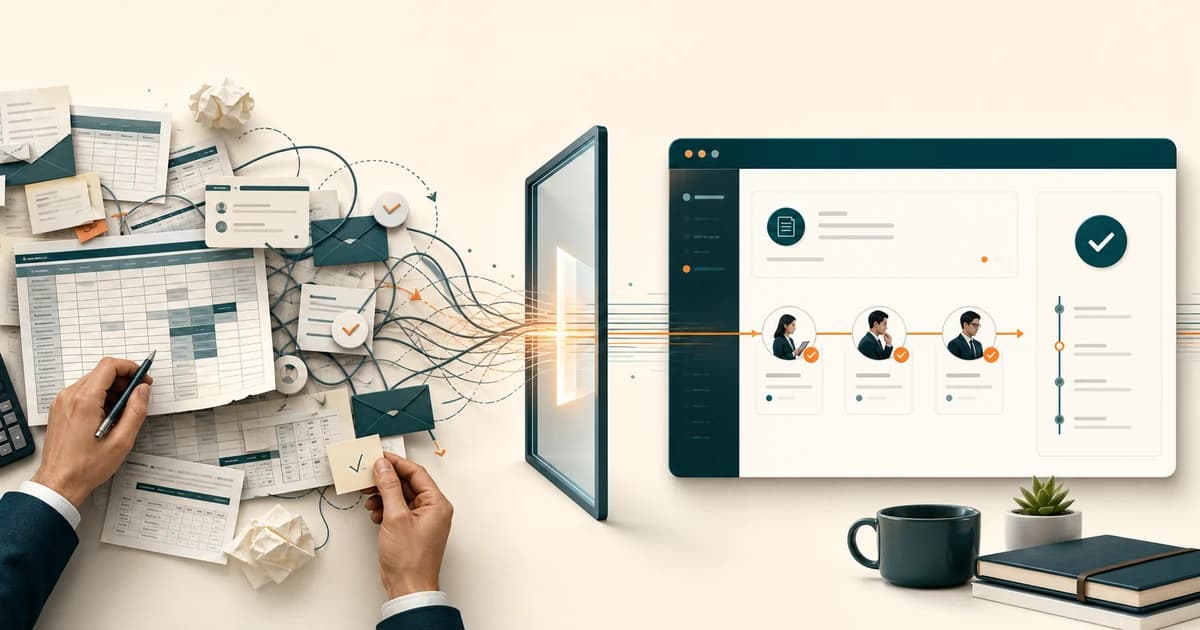

AI Automation Malaysia: Costs & First Workflows for SMEs
Compare five candidate workflows, understand what affects project costs, and estimate payback using your own operating data before choosing an AI automation project.
Want this built for your business? Start with your priority workflow and a fixed quote. A focused sprint typically takes 2-3 weeks, with scope agreed first.
Where AI Automation Fits in an SME
Start with a process your staff can describe and show using real examples. AI can help interpret messages and documents, while rules can handle known approvals and routing. The useful question is which combination solves a defined task with an acceptable review burden.
Before choosing tools, map where the work starts, which systems hold the required data, and who approves the result. Check whether configuration in your existing software can solve the problem before commissioning an integration or custom build. This guide covers how to choose and cost a first project; if you want one scoped and built for you, see our AI workflow automation service.
What Is AI Workflow Automation?
AI workflow automation is software that carries a repeated business task from start to finish across the tools you already use, such as your accounting system, CRM, email, WhatsApp, and shared folders. AI handles the steps that need reading, such as pulling fields from a scanned invoice or sorting an incoming enquiry, while fixed rules handle routing and approvals. A person still reviews exceptions and anything the system is not sure about.
The difference from traditional robotic process automation (RPA) is the input. RPA follows fixed rules and repeats the same clicks every time, so it suits clean, structured data. AI can also read unstructured inputs such as scanned documents, emails, and free-text messages, and turn them into structured data the rules can act on.
A simple example: instead of your accounts team matching purchase orders to invoices by hand, an AI agent checks them in the background, pre-fills the reconciliation form, and escalates exceptions to a human. The team reviews instead of processing every line.
What Counts as an Automatable Workflow
Not every repeated task makes a good first project. A workflow is a candidate when it runs often enough for the saving to show up in a month, its inputs arrive somewhere predictable, and someone can state the decision rules without falling back on "it depends". A workflow that fails all three belongs later in the queue, whatever its annoyance value.
Five Workflows to Compare for Your First Project
These are candidate workflows, not a ranking or a promise of savings. Compare their volume, handling time, exceptions, and integration needs. For a task requiring controlled access and human approval, see AI agent development.
- Invoice and PO matching: reconcile supplier invoices against purchase orders and flag discrepancies before they become disputes.
- Customer enquiry routing: AI reads incoming WhatsApp and email enquiries, extracts key details, and routes them to the right person with a pre-filled response draft. For the service itself, see AI chatbot Malaysia; for what a WhatsApp build costs and how it is set up, read the WhatsApp chatbot price guide.
- Approval chains for leave, expenses, and procurement: replace email chains with a one-click manager review flow. Where purchasing is the bottleneck rather than leave or claims, an e-procurement system carries the live budget check and the audit trail as well.
- Document data extraction: pull structured data from scanned documents, delivery orders, and forms into your ERP without manual re-keying.
- Scheduled reporting: generate weekly sales, inventory, or HR reports and deliver them to the right stakeholders every Monday morning.
Realistic Costs of AI Automation in Malaysia
GreatRise runs AI automation sprints typically priced at RM 8,000-15,000 for a 2-3 week implementation. Start with your highest-priority process, then agree the workflow scope, systems, approvals, exceptions, and schedule in writing. Data cleanup, additional integrations, model or platform subscriptions, and ongoing support can change the total cost.
Estimate payback as setup cost divided by monthly benefit after recurring costs. If the monthly benefit is zero or negative, there is no payback under those assumptions. Record the current volume and handling time, then check the result after rollout before expanding.
What About Data Privacy and PDPA Compliance?
List the personal or confidential data in the workflow before selecting a platform. Identify who can access source documents, which fields reach a model provider, what is logged, and how deletion or retention will work. Include these questions in the implementation scope and privacy review.
A Local LLM deployment is an option when your organisation needs greater control over model hosting. Review the whole data path, including integrations, backups, and support access; choosing local hosting alone is not a compliance assessment.
How to Choose an AI Automation Partner in Malaysia
The Malaysian market has seen a surge in vendors claiming AI expertise. When evaluating a partner, ask these questions:
- Do they have experience integrating AI with Malaysian accounting and ERP systems (Biztrak, SAP, Oracle, SQL Account)?
- Can they demonstrate a working example instead of only a slide deck?
- Do they understand LHDN e-Invoice requirements and PDPA obligations?
- Do they offer a fixed-scope, fixed-price engagement or open-ended retainers?
- Is there a local presence for on-site support if needed?
The right partner will be upfront about what AI can and cannot do, work within your existing technology stack rather than replacing it, and deliver a working prototype before asking for a long-term commitment. If you are considering a custom AI chatbot or end-to-end custom AI solution, apply the same evaluation criteria.
Getting Started: Your First Step
Start with a review of one workflow, its data quality, and the systems it touches. Bring sample inputs with sensitive details removed, current handling steps, transaction volumes, and known exceptions. This gives the team a basis for estimating scope and deciding what to test.
GreatRise IT Consulting has delivered business systems from Kuching, Sarawak since 2009. Our current services include AI integration and workflow automation. Our AI workflow automation sprints are fixed-scope engagements: we scope the workflow together, build and integrate in two to three weeks, and hand over a working system with documentation and training. Confirm exclusions and recurring costs in the proposal. Where the process runs on rules, forms, and approvals rather than documents, business process automation is the closer fit.
If your team is not ready for a full automation roadmap yet, start with one daily task for a small business. Pick the pile a clerk already opens every morning, then compare it with the candidates above.
Frequently Asked Questions
How much does AI workflow automation cost in Malaysia?
At GreatRise IT Consulting, AI automation sprints are typically RM 8,000-15,000 for a 2-3 week implementation. The workflow scope, systems, approvals, exceptions, and price are agreed in writing before work starts. Model usage and platform subscriptions are billed separately by the provider, and data cleanup or extra integrations can change the scope.
Which business workflows should Malaysian SMEs automate first?
Start with a workflow that runs every week, takes staff time you can measure, and follows rules someone can state clearly. Common candidates are invoice and PO matching, customer enquiry routing on WhatsApp and email, leave and expense approvals, document data extraction into your ERP, and scheduled reporting. Compare them on your own volume, handling time, exceptions, and integration effort rather than assuming one has the fastest return.
How long does a first automation project take to pay for itself?
There is no guaranteed payback period. Estimate the setup cost divided by the monthly benefit after recurring software and support costs. Use measured processing time, volume, exception rates, and realistic staff costs; distinguish time freed for other work from cash actually saved.
How long does an AI automation project take?
A focused, fixed-scope sprint typically takes 2-3 weeks, including agreed integrations, testing, and staff training. An initial custom AI workflow typically takes 2-6 weeks depending on scope and integrations. Larger programmes are delivered in phases, with the scope and schedule agreed after assessment.
Is AI workflow automation PDPA compliant?
Review the data involved, who can access it, where it is processed, how long it is retained, and which providers receive it. A cloud or local deployment needs its own privacy review; the hosting choice alone does not establish compliance.
Ready to Automate Your First Workflow?
Describe the process that takes up your team time. We will review the inputs, systems, and exceptions with you and prepare a scoped proposal.