
AI Chatbot Malaysia That Answers From Your Own Documents
A WhatsApp or website assistant that answers from your SOPs, product information, and policies, with source references and human handover.
Free scoping call. Fixed scope, quoted before we build.
Built for Malaysian businesses that need answers from their own documents. It handles repeated customer questions, flags what it cannot answer, and hands the conversation to your team with the context attached. Compare the build scope and running costs below.
Where Business Chatbots Break
Template chatbots give wrong answers and damage trust.
Support teams repeat the same FAQ responses daily.
Knowledge lives across PDFs, SOPs, and shared drives.
No control over what the bot can and cannot say.
Enquiries land on WhatsApp after hours and sit unread until morning.
Customers mix English, Malay, and Chinese in one message and the bot gives up.
The answer the customer wants lives in the stock or order system, not in a PDF.
Nobody can see which questions the bot failed to answer last week.
What an AI Chatbot Malaysia Project Includes
An AI chatbot for a Malaysian business reads your own documents — SOPs, price lists, product sheets, policies — and answers customer or staff questions from them on WhatsApp, your website, or an internal chat tool, citing the document each answer came from. Here is what a build produces.
What You Get in a Chatbot Build
A fixed-scope build covering one channel and one knowledge base, with the guardrails and escalation rules agreed before anything goes live in front of customers.
Fixed scope, typically RM 8,000-15,000
Before and After: AI Chatbot Workflows
WhatsApp Customer Support FAQ
Internal SOP Assistant
WhatsApp Lead Capture
Appointment and Booking Triage
Order and Stock Status Enquiries
Product and Price Enquiries
What an AI Chatbot Is, and How It Differs From a Scripted Bot
An AI chatbot is software that reads a question written in ordinary language, finds the answer in the company's own approved information, and replies in a sentence rather than a menu. A scripted chatbot matches keywords or button presses against a flowchart somebody drew in advance. The difference in practice is that the AI one still works when a customer types something nobody predicted.
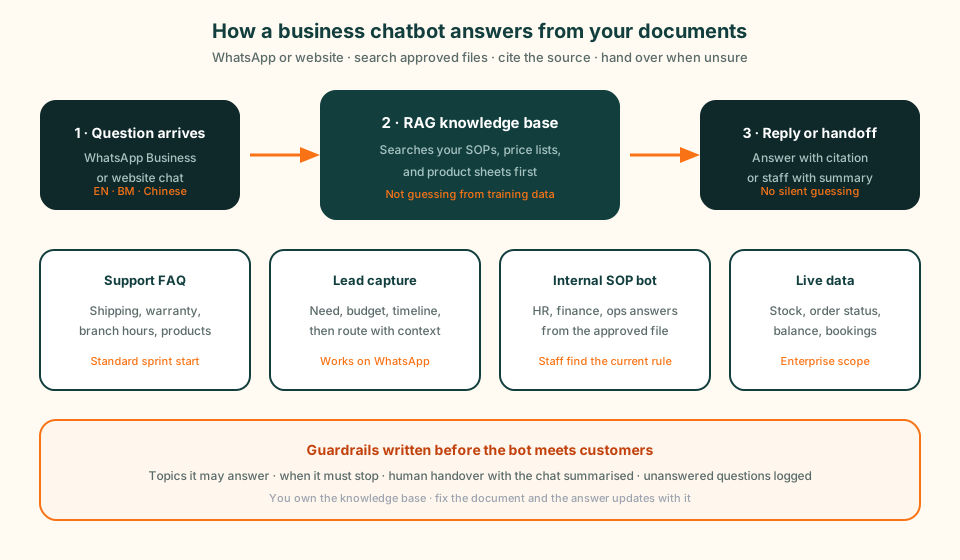
The technique underneath most business chatbots worth paying for is retrieval-augmented generation, usually shortened to RAG. The bot searches your documents for the relevant passage first, then writes its answer from what it found, and cites the source. It is not the model recalling something from training. It is the model reading your price list, your warranty terms, or your SOP at the moment the question is asked, which is what makes the answers correctable: you fix the document, and the answer changes with it.
Whether one works in a Malaysian business, and not only in a demo, comes down to three practical things. Customers here message on WhatsApp far more than they use a website widget, so the channel is usually WhatsApp or nothing. Enquiries arrive in mixed English, Malay, and Chinese, often inside a single sentence. And the questions that matter most — stock, price, delivery status, outstanding balance — have answers that live in a system, not in a document, so the bot either connects to that system or it hands over. A bot that handles all three is a build. A bot that handles the first one only is a subscription.
| The situation | Scripted or template bot | AI chatbot answering from your documents |
|---|---|---|
| An unexpected phrasing | Falls back to a menu or repeats itself. | Interprets the question and answers, or escalates. |
| Where the answer comes from | Replies typed into the flow in advance. | Your approved documents and systems, cited back to source. |
| Keeping it current | Someone rebuilds the flow. | Someone updates the document; the answer follows. |
| Mixed English, Malay, and Chinese | Breaks unless a separate path was built per language. | Answers in the language the customer used. |
| When it should not answer | Has no concept of not knowing. | Guardrails stop it and it hands over with the conversation summarised. |
What an AI Chatbot Costs in Malaysia, Honestly
Nobody publishes chatbot pricing in this market, which makes it hard to tell a fair quotation from a bad one. Here is how ours breaks down and what to check in anyone else's.
A build with us is a fixed-scope sprint, typically RM 8,000-15,000, covering one channel and one knowledge base — the content audit, the RAG build, guardrails and escalation, deployment, and training. What moves a project toward the upper end is rarely the chatbot itself. It is the number of source systems it has to read from, whether answers must be pulled live from stock, order, or booking data instead of static documents, and how many languages need checking before launch.
Enterprise scope starts from RM 15,000 and is quoted on complexity. That is the band for several channels at once, answers pulled live from systems of record, multi-language checking before launch, or deployment on a private or local model. We quote it after scoping, because at that size the number is decided by your systems, not by ours.
Then there are the running costs, which are separate from the build and easy to miss in a quotation. Model usage is billed per token by whichever provider you use, so a busy support bot costs more per month than a quiet internal SOP assistant. If you deploy on WhatsApp, Meta bills messaging through the WhatsApp Business Platform separately again — that is a Meta charge, not a developer charge, and any vendor who folds it silently into their own invoice is worth a question. Our free AI token cost converter gives you a monthly estimate in MYR before you commit.
The comparison that matters most is not between two builders. It is between paying once and paying every month. Subscription platforms are the cheaper way to start and stay cheaper for simple, low-volume flows. A build costs more on day one and stops climbing after it.
| What you are choosing between | Indicative cost | Who it suits |
|---|---|---|
| Free or template chatbot | RM 0 | Opening hours, delivery timelines, and a dozen predictable questions. |
| Subscription chatbot platform | Monthly fee per tier, set by the vendor | Standard flows, cloud apps already in place, modest conversation volume. |
| Custom build, standard scope | RM 8,000-15,000, one-off | One channel and one knowledge base, answering from your own documents with escalation. |
| Custom build, enterprise scope | From RM 15,000, quoted on complexity | Several channels, live data from stock, order, or booking systems, multi-language, or a private model. |
| Running costs, any custom build | Billed by the provider, not by us | Model usage per token; WhatsApp messaging billed by Meta on top. |
Why Subscription and Custom Pricing Cannot Be Compared Directly
We do not quote a figure for what subscription platforms charge, because any number we published would be out of date by the time you read it. Tiers get renamed and repriced, and the conversation limit attached to a tier usually matters more than the headline fee. Take the current number from the vendor you are actually shortlisting, and ask what happens to it when you pass the cap.
The trap in comparing that number to a build is that one is a rental and the other is a purchase. A subscription keeps costing every month for as long as the bot runs; a build stops after handover. At the end of a subscription you own nothing: your content lives in their account, and your conversation history leaves with them. That is a fair trade when the flows are simple and you want the option to stop any time. It stops being a fair trade once the bot is load-bearing.
The other difference is what the money buys. Subscription pricing buys a builder you configure yourself, so your team carries the work of writing the flows, keeping the answers current, and noticing when it breaks. A build is priced with that work inside it: the content audit, the guardrails, the escalation rules, and the handover. If you have someone who enjoys owning it, the subscription is genuinely the better buy.
Four Kinds of Business Chatbot, and Which One You Are Asking For
Most chatbot enquiries arrive asking for "a chatbot", which is four different projects with four different price tags. Working out which one you mean is usually the fastest part of a scoping call, and it decides everything after it.
Customer Support Bot
Answers the repeat questions on your busiest channel: opening hours, delivery status, warranty terms, product details, branch information. Reads from documents you approve. This is the standard sprint, and it is where most businesses should start.
Sales and Lead Qualification Bot
Talks to an enquiry before a human does. Captures the need, budget, timeline, and contact details, then routes the lead with the conversation summarised. Works best on WhatsApp, because that is where the enquiry already arrived.
Internal SOP and Knowledge Assistant
Points inward rather than outward. Staff ask HR, finance, or operations questions and get the current approved procedure instead of whatever the longest-serving person remembers. Often the easiest to launch, because the audience will tell you plainly when an answer is wrong.
Live-Data Assistant
Answers questions whose answer changes hourly: stock on hand, order status, outstanding balance, booking availability. It has to query your ERP, order system, or database at the moment of asking, which is what moves a project into enterprise scope.
Free Chatbot Tools vs a Custom AI Chatbot
A free or template chatbot is a genuinely reasonable starting point, and we will say so when it is. If you need to answer opening hours, delivery timelines, and a dozen predictable questions, a scripted bot on your website does that at no cost and takes an afternoon.
The reason businesses come to us is usually that they have already tried one and hit its ceiling. Scripted bots break the moment a customer phrases something unexpectedly, they cannot read your actual price list or SOPs, they have no notion of when to stop guessing and fetch a human, and they leave no usable record of what people are actually asking. A RAG chatbot answers from your approved documents and cites where the answer came from, which is what makes it safe to put in front of customers.
The practical test: if a wrong answer from your bot would cost you a sale, a complaint, or a compliance problem, you need guardrails and escalation, and that is the line where custom work starts paying for itself.
Answering in Malay, English, and Chinese
Most Malaysian support queues are trilingual in practice, and mixed within a single message more often than not. A customer opens in Malay, drops an English product name in the middle, and closes with a Chinese phrase. A scripted bot with three separate language menus handles that badly.
A RAG chatbot handles it by separating the language of the question from the language of the source. Your SOPs and price lists can stay in whichever language they were written in, and the bot retrieves the right passage and answers in the language the customer used. What it must not do is translate a policy or a price on the fly and present that translation as authoritative, so anything with legal or financial weight gets a fixed, approved wording per language, signed off before launch.
That approved wording is the actual work, and it is why more than one language is one of the four things that pushes a project from a standard sprint into enterprise scope. Someone who reads the language has to sign off the answers before launch. That is a review cycle per language, not a setting to switch on.
Putting an AI Chatbot on WhatsApp in Malaysia
WhatsApp is where most Malaysian customers actually message businesses, so it is the channel we are asked about most. It is also the one with real setup requirements, and knowing them up front prevents an unpleasant surprise three weeks in.
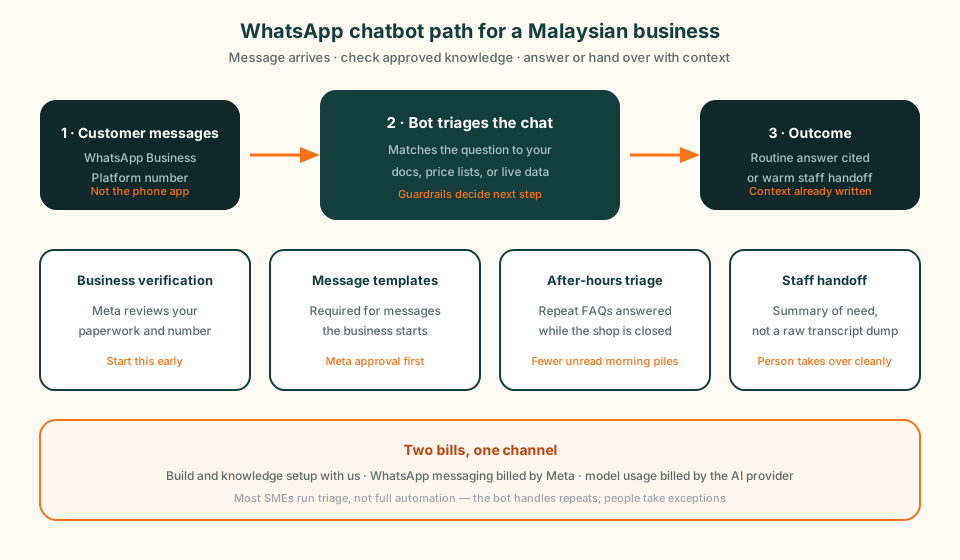
An automated WhatsApp bot runs on the WhatsApp Business Platform, not the ordinary WhatsApp Business app on someone's phone. That means a verified business account, an approved sender number, and message templates that Meta reviews before you can use them for anything you initiate. Business verification is the step that most often adds time to a project, and it depends on your paperwork, not our development speed, which is why we start it early.
Once live, the pattern that works for most SMEs is not full automation. It is triage: the bot handles the repetitive questions, captures details on a genuine enquiry, and hands a warm, summarised conversation to a human the moment it hits anything it should not answer alone.
What to Check in Any Chatbot Quotation
We publish our numbers because most of this market does not, and an unpriced quotation is hard to judge against anything. If you are comparing us against someone else, these are the questions that separate a fair quotation from one that gets expensive later. Ask us the same ones.
The WhatsApp channel in detail: setup steps, first workflows, and PDPA duties.
For when the bot needs to do more than answer: trigger an approval, or update a record.
Deployment inside your own environment, for data that cannot leave it.
Not sure whether you need a chatbot or a workflow?
Send us the ten questions your team answers most often. We will tell you which ones a bot should take, which ones it should never touch, and what that build would cost.
Channels and Systems We Connect
Guardrails and Data Protection
Keep control of your data and comply with internal governance. We can deploy in your environment with clear retention and access rules.
Custom Chatbot Delivery Process
Content Audit
Select the documents and SOPs the bot may answer from, agree what is already out of date, and start WhatsApp business verification if that is the channel.
RAG Build
Create a structured knowledge base with citations back to the source document.
Guardrails
Define what the bot may answer, when it must stop, and how it hands the conversation over.
Launch
Deploy, watch the real questions arrive, and tune the answers through the first weeks.
Kuching, Sarawak Support and Training
We are based in Kuching, Sarawak. Projects are delivered with clear documentation, training, and ongoing support.
Related AI Services
Automate tasks beyond chat.
Kuching-based AI team serving all of Sarawak.
Consulting and build when the problem is bigger than chat.
Extract data from invoices and forms, not just answer questions about them.
When it has to act on the answer, not only give it.
AI Chatbot Malaysia FAQ
An AI chatbot for business answers customer or staff questions in ordinary language using the company's own approved information, rather than following a fixed script of buttons. It runs on a website, on WhatsApp, or on internal chat, cites where its answer came from, and hands over to a person when the question falls outside what it is allowed to answer. The difference from a template bot is that it still works when a customer phrases something nobody predicted.
Yes. We can connect an AI chatbot to WhatsApp Business, website chat, or internal channels, with routing, handover, and message guardrails for Malaysian SMEs.
A free chatbot usually follows fixed scripts. A custom AI chatbot uses your SOPs, product details, policies, and integrations to answer more useful questions with better control.
Yes, and it is worth testing before launch. Malaysian customers routinely switch language mid-sentence, and a scripted bot built with one flow per language breaks on the first mixed message. A RAG chatbot interprets the question and replies in the language the customer used. Where your approved answers only exist in one language, we agree during the content audit whether the bot translates them or escalates, because an unreviewed translation of a warranty term is not something to guess at.
Yes. Where the data cannot leave your infrastructure — patient records, employee files, unreleased pricing — we deploy the model inside your environment or private cloud instead of calling a public API. It changes the shape of the cost rather than just the number: you take on hosting and hardware, and the choice of model narrows to what runs well on the machine you have. Private deployment is enterprise scope, starting from RM 15,000 and quoted on complexity.
Our chatbot builds are fixed-scope sprints, typically RM 8,000-15,000, covering one channel and one knowledge base — content audit, RAG build, guardrails and escalation, deployment, and training. Enterprise scope starts from RM 15,000 and is quoted on complexity. Running costs are separate: model usage is billed per token by the provider, and WhatsApp messaging is billed by Meta. We give you a monthly estimate in MYR before you commit.
Four things, and they are all about your systems. Several channels running at once instead of one. Answers pulled live from stock, order, or booking systems instead of static documents. More than one language needing sign-off before launch. Or deployment on a private or local model because the data cannot leave your infrastructure. Any of those puts a project above RM 15,000, and we quote it after scoping.
At the start, yes, and for simple flows it stays cheaper. A subscription is the better buy when the questions are predictable, the volume is modest, and someone on your team will own it. What changes the answer is time and dependence: the subscription keeps billing every month for as long as the bot runs, while a build stops after handover, and at the end of a subscription your content sits in the vendor account and your conversation history leaves with them. Get the current monthly figure from the platform you are shortlisting, check what it does when you pass the conversation cap, and we will tell you which side of that line you are on during the scoping call.
An automated bot runs on the WhatsApp Business Platform, not the WhatsApp Business phone app, so you need a verified business account, an approved sender number, and message templates reviewed by Meta for anything the bot initiates. Business verification depends on your documentation and is usually the longest lead time in the project, so we start it at the beginning.
It says so and hands over, which is a design decision, not a limitation. Guardrails define the topics the bot is allowed to answer, and anything outside them — or anything it is not confident about — escalates to a human with the conversation summarised so your staff are not reading from the top. A bot that guesses is worse than no bot at all.
RAG stands for retrieval-augmented generation. The bot searches your approved documents for the relevant passage first, then writes its answer from what it found and cites the source. It is not recalling something learned during model training, which is why the answers stay correct when your price list changes: you update the document, and the answer updates with it.
There is no single best one, and any answer that names a product before asking about your channel is guessing. It comes down to which channel your customers already message you on, whether the answers live in documents or in a live system, and whether a wrong answer would cost you a sale, a complaint, or a compliance problem. Predictable questions on a website widget point to a subscription platform, billed monthly on a tier you pick. Enquiries arriving on WhatsApp that need answers from your own price lists, stock, or SOPs point to a build, typically RM 8,000-15,000 for a standard scope.
The build is a fixed-scope sprint measured in weeks, and it moves at the speed of two things that sit outside the development work. The first is your content: if the documents the bot will answer from are current and in one place, the knowledge base comes together quickly, and if they are scattered across five drives with three versions of the price list, that is the delay. The second is WhatsApp business verification, which depends on Meta reviewing your paperwork, not on us, and is usually the longest single lead time in the project. We start verification at the beginning and scope the content audit before quoting, so the date we give you is one we can hold.
Website chat and WhatsApp Business cover most Malaysian SME demand, and one channel is what a standard sprint includes. We also deploy to Microsoft Teams or Slack for internal assistants. Running several at once is one of the things that moves a project to enterprise scope, because each channel has its own approval process, message formatting, and handover behaviour to get right.
Yes, and this is the point where a chatbot stops being a document reader. Those answers change hourly, so the bot has to query your ERP, order system, or database at the moment of asking instead of reading a file. That needs an API or database route into the system, permission rules for who is allowed to see what, and an agreed behaviour for when the system is down. It is enterprise scope for those reasons, starting from RM 15,000 and quoted after we have seen the systems involved.
Compliance is a property of how you run it, not of the software you buy. A chatbot handles names, phone numbers, order details, and whatever a customer volunteers in a message, all of which is personal data under the Personal Data Protection Act 2010. We build to the same rules as any system holding that data: collect only what the workflow needs, mask what does not need storing, agree a retention period before launch instead of accepting a vendor default, and keep access controlled and logged. Where the data cannot leave your infrastructure at all, the chatbot can run on a private or local model instead.
You do, and we build it so you can. The knowledge base is your own documents, so a price change or a new policy is a document update rather than a development ticket. What we hand over is the content audit that records which documents the bot is allowed to read, the analytics that show which questions it failed on, and the training to act on both. Ongoing support is available where a team would rather not own it, but the design assumption is that you can.
Book a Free Chatbot Scoping Call
Bring the questions your customers actually ask. You do not need a brief, and one call is usually enough to tell you whether you need a subscription, a standard sprint, or an enterprise build.