e-Invoice Malaysia 2026: Who Is Exempt, Who Must Comply, and What Changed
The exemption threshold doubled to RM1 million and the planned Phase 5 never happened — so a large share of Sarawak micro-businesses are out of scope entirely. Here is the schedule as LHDN publishes it today, verified 5 August 2026.
The Rule That Changed: RM1 Million, Not RM500,000
On 7 December 2025 the e-Invoice exemption threshold was doubled from RM500,000 to RM1,000,000 in annual turnover. That single change moved a large share of Malaysia's smallest businesses out of the mandate entirely — and it quietly cancelled the fifth phase that had been expected on 1 July 2026, because the businesses it would have covered are now exempt.
This matters in Sarawak, where a great many registered businesses turn over well under RM1 million. If that is you, you have no e-Invoice deadline. You are not late, and you do not need to buy anything. Plenty of guides published in early 2026 — and plenty of software vendors still quoting them — say otherwise, because they were written before the threshold moved.
So Do You Actually Have to Comply?
Work through it in this order:
- Annual turnover below RM1,000,000 — you are exempt. No implementation date applies to you.
- Annual turnover above RM1,000,000 — you are in scope, and your implementation date has already passed (see the timeline below). You should be issuing e-Invoices now.
- Close to the line, or growing — you will enter the mandate when you cross it, so it is worth choosing e-Invoice-capable accounting software at your next upgrade rather than migrating under time pressure.
- Exempt but selling to larger companies — your customers may still ask you for compliant invoices, or issue self-billed e-Invoices on your behalf. Being exempt does not always mean being unaffected.
What Is e-Invoice and Why Does It Matter?
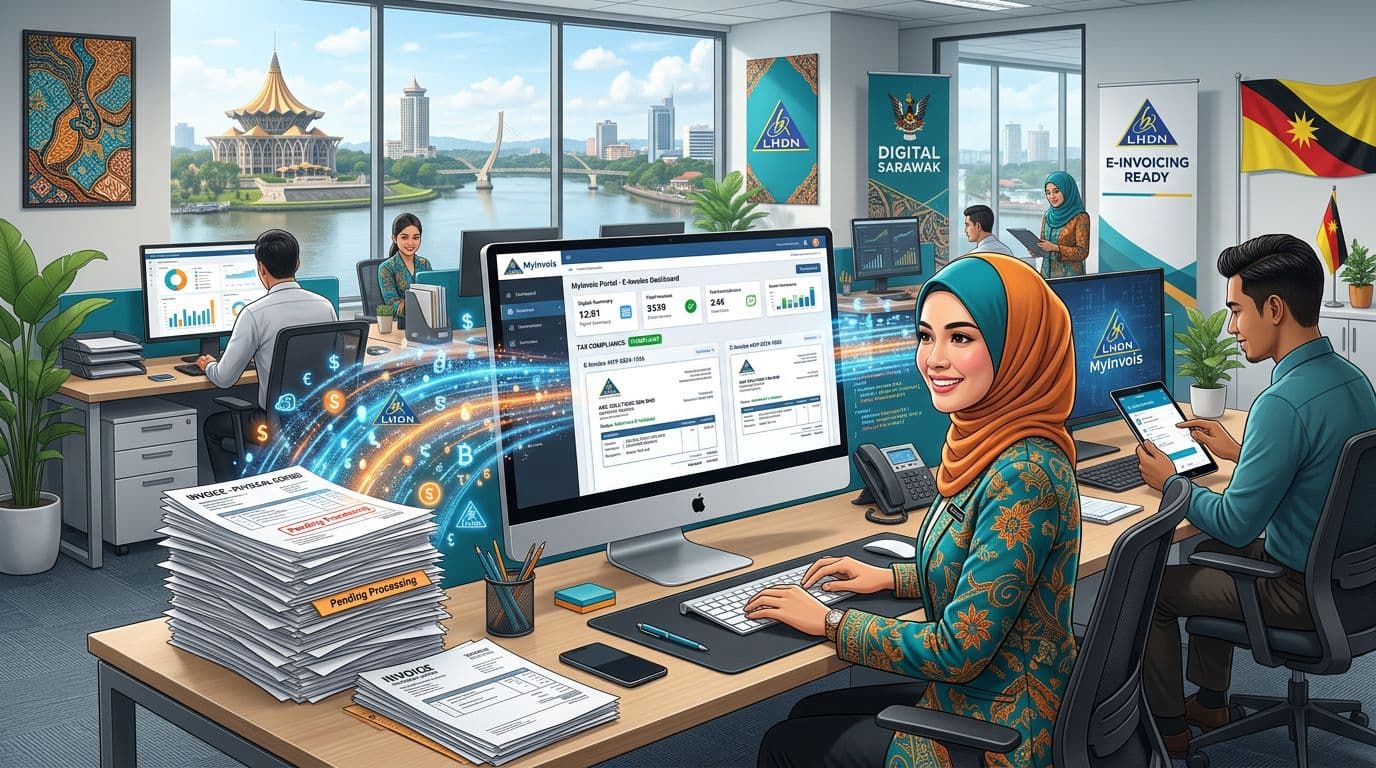
e-Invoice, or e-Invois in Bahasa Malaysia, is a digital invoicing system mandated by LHDN (Inland Revenue Board of Malaysia) through the MyInvois portal. Instead of issuing paper or PDF invoices, businesses must submit invoices electronically to LHDN in real time. Each invoice receives a unique identifier and QR code, making it traceable, tamper-proof, and verifiable by both parties and the tax authority.
e-Invoice does more than satisfy compliance. It eliminates manual data entry errors, speeds up payment cycles, simplifies tax filing, and gives businesses a clean digital audit trail. For Sarawak businesses dealing with cross-state transactions and government contracts, it also improves the procurement-to-payment chain.
e-Invoice Timeline: Key Dates and Turnover Thresholds
This is the schedule as it appears on the official LHDN e-Invoice implementation timeline, checked on 5 August 2026. Four phases, not five:
- Phase 1 — 1 August 2024: turnover above RM100 million.
- Phase 2 — 1 January 2025: turnover above RM25 million up to RM100 million.
- Phase 3 — 1 July 2025: turnover above RM5 million up to RM25 million.
- Phase 4 — 1 January 2026: turnover up to RM5 million.
- Exempt: annual turnover below RM1,000,000 — outside the mandate, with no implementation date.
- All B2B and B2G invoices must be submitted through the MyInvois portal or via API integration; self-billed invoices, credit notes, and debit notes are in scope, while B2C transactions use consolidated e-Invoices.
- Since 1 January 2026, any single transaction above RM10,000 needs its own individual e-Invoice — it can no longer be swept into a consolidated one.
One Thing to Verify Yourself: the Relaxation Period
Each phase came with a relaxation period allowing simplified treatment before full enforcement, and this is the part of the schedule that has been revised repeatedly. Third-party guides currently disagree with each other about when the relaxation for the up-to-RM5-million band actually ends — we have seen 30 June 2026, 31 December 2026, and 31 December 2027 all stated with confidence, and the official timeline page does not settle it.
So we are not going to add a fourth confident-sounding date to that pile. If the relaxation end date affects a decision you are making, confirm it against the LHDN timeline or the current e-Invoice guideline PDF on the day you need it. The thresholds above have been stable since December 2025; the relaxation dates have not.
The Two Paths to Compliance: Portal vs API Integration
LHDN offers two ways to submit e-Invoices. The first is the MyInvois Portal, a web interface where your team keys in invoice details. This works for businesses issuing a small number of invoices per month, but it becomes slow and error-prone beyond a handful of transactions.
The second option is API integration. This connects your existing accounting or ERP system, such as Biztrak, SQL Account, SAP, QuickBooks, or custom software, directly to the MyInvois platform. Invoices submit as part of your normal billing workflow. No double entry, no manual uploads, no delays. For any business issuing more than 20 to 30 invoices per month, API integration is the sensible approach.
What Your Accounting System Needs to Be Ready
Not every accounting system is e-Invoice ready out of the box. Check these items with your current setup:
- Does your software support the MyInvois API (Version 1.0 or later)?
- Can it generate invoices in the required XML or JSON format with all mandatory fields (TIN, BRN, MSIC code, classification codes)?
- Does it handle the unique identifier and QR code returned by MyInvois after validation?
- Can it process credit notes, debit notes, and self-billed invoices through the same integration?
- Is there a sandbox or testing environment so you can validate before going live?
If your current system cannot do these things, you have two options — compared side by side on our e-Invoice software page: upgrade to a version that supports e-Invoice (most major Malaysian accounting software vendors have released updates), or engage an IT consultant to build a middleware integration layer between your existing system and MyInvois. Many Sarawak businesses pair this upgrade with AI automation so invoice data entry, validation, and follow-up stop being manual work altogether.
Common Mistakes Sarawak Businesses Are Making
From our work with businesses in Kuching and across Sarawak, these are the most common pitfalls:
- Waiting until the last month before the deadline. Integration and testing take time, and vendor backlogs are real.
- Assuming their accounting software is already compliant without verifying the specific MyInvois API version.
- Forgetting about self-billed invoices. Many businesses do not realise these are also within scope.
- Not updating their business registration details (TIN, MSIC codes) with LHDN, which causes validation errors.
- Treating e-Invoice as an IT-only problem. It requires coordination between finance, operations, and IT teams.
How Biztrak Handles e-Invoice Compliance
For businesses using Biztrak ERP, one of the most widely deployed accounting platforms in Sarawak, the e-Invoice integration is built in. Biztrak connects directly to the MyInvois API, submits invoices upon approval, retrieves the unique identifier and QR code, and stores everything within the existing document management system. Credit notes, debit notes, and self-billed invoices are all supported.
As an authorised Biztrak implementation partner, GreatRise IT has been deploying e-Invoice configurations for clients across Sarawak. The typical setup takes three to five business days, including testing in the LHDN sandbox environment and go-live validation.
Your Step-by-Step e-Invoice Action Plan
If you have not started your e-Invoice compliance process yet, use this sequence:
- Verify your LHDN profile: confirm your TIN, BRN, and MSIC codes are correct and up to date.
- Check your accounting software: contact your vendor or IT partner to confirm MyInvois API support.
- Register on the MyInvois portal: set up your business profile and API credentials.
- Test in sandbox: submit sample invoices through the testing environment to catch formatting or data issues.
- Go live: switch to production and monitor the first batch of real invoices for validation success.
- Train your team: ensure your finance and admin staff understand the new workflow and what to do if a submission fails.
Do Not Let Anyone Sell You a Deadline You Do Not Have
The most useful thing on this page may be the part that saves you money: if your annual turnover is under RM1 million, you are exempt, and any quotation that opens by telling you that you are about to miss a mandate deserves a hard question. Ask the vendor which turnover band they are placing you in and which LHDN date they are citing. If they say "Phase 5", they are working from a schedule that no longer exists. Check your own position in two minutes with our free e-Invoice readiness checker.
Frequently Asked Questions
When is e-Invoice mandatory for my business in Malaysia?
It depends on your annual turnover. Businesses above RM100 million started on 1 August 2024, above RM25 million on 1 January 2025, above RM5 million on 1 July 2025, and everyone above RM1 million up to RM5 million on 1 January 2026. If your annual turnover is below RM1 million you are exempt and have no implementation date at all.
Is my business exempt from e-Invoice in Malaysia?
If your annual turnover is under RM1,000,000, yes — LHDN exempts you from e-Invoice entirely. This threshold was doubled from RM500,000 on 7 December 2025, which moved a large number of micro-businesses out of scope. Many guides still quote the old RM500,000 figure, so check the date on anything you read.
What happened to e-Invoice Phase 5?
There is no Phase 5. A fifth phase covering the smallest businesses was expected around 1 July 2026, but when the exemption threshold rose to RM1 million that group became exempt instead. LHDN's official timeline now shows four phases only. If a vendor is telling you that you must comply because of "Phase 5", check your turnover against the RM1 million exemption first.
How do Sarawak businesses submit e-Invoices to LHDN?
There are two paths: keying invoices into the free MyInvois portal, or integrating your accounting/ERP system with the MyInvois API so invoices submit automatically. For businesses issuing more than 20-30 invoices a month, API integration through software like Biztrak is the practical option. GreatRise IT deploys these integrations across Sarawak in 3-5 business days.
Need Help with e-Invoice Compliance?
GreatRise IT has been deploying MyInvois integrations for Sarawak businesses since Phase 1. Get a free compliance assessment and fixed-price setup.
Related Articles
From Excel Stock Control to Controlled Stock: A Sarawak Guide
Read article
AI Automation for Small Businesses in Malaysia: Start With One Daily Task
Read article