E-Procurement Malaysia

E-Procurement System Built Around Your Approval Chain

Purchase requests, budget checks, approvals, and purchase orders — online, tracked, and auditable.

GreatRise builds e-procurement systems for Malaysian organisations that need control over purchasing: from the first request through approval, purchase order, supplier invoice, and payment, with live budget checking at every step.

Procurement Problems We See Most Often

Every request waits at each level of authority, and one signature can hold up a purchase for days.

Once a paper form leaves the desk, nobody can say which approver is holding it.

Approvers cannot see the remaining budget at the moment they approve.

Purchase requests, quotations, and approvals live across Excel files and email threads.

Purchasing records are scattered, so audits take weeks to prepare.

What an E-Procurement System Changes

Procurement is where control and speed usually pull against each other. A proper system gives you both: requests move faster because the checking is built in.

One portal for purchase requests, from any department or branch.
Approvals routed by amount, category, and department rules.
Live budget checking before a request can be approved.
Purchase orders generated from approved requests.
Vendor records, quotations, and deliveries tracked in one place.
A complete audit trail for every purchase.

Procurement Workflows in Practice

Purchase Request to Purchase Order

Before: A paper form is signed by several managers over days or weeks.
After: The request is submitted online, routed automatically, and becomes a PO on approval.
Impact: Faster purchasing with every step recorded.

Budget Check at Approval Time

Before: Overspending is discovered at month end, after commitments are made.
After: The system shows the live budget balance and blocks or flags over-budget requests.
Impact: Spending controlled before it happens, not after.

Vendor Quotation Comparison

Before: Quotes arrive by email and are compared in a spreadsheet.
After: Vendors submit through a portal; comparisons and selection reasons are recorded.
Impact: Transparent selection with a defensible record.

Dual Approval Chains for Semi-Government Organisations

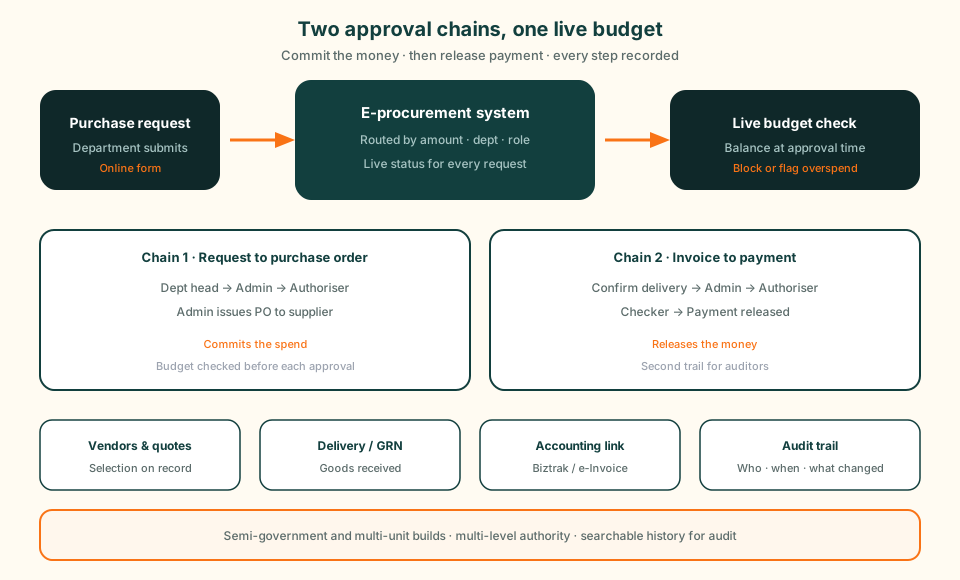
Procurement is not one workflow, it is two. The first commits the money; the second releases it. Most organisations run both on paper, which is why a purchase can stall twice.

This is the part standard platforms handle least well, and it is the work we have done most. Our procurement builds have been delivered for semi-government and multi-unit organisations where authority runs several levels deep, the budget figure has to be visible at the moment of approval, and every decision has to survive an audit years later. If your approval matrix has exceptions, delegation, and escalation that a product cannot express, that is the case a build is for.

Diagram of e-procurement: purchase request flows into the system with live budget check, then two chains — request to purchase order, and supplier invoice to payment — plus vendors, delivery, accounting, and audit trail.
Chain 1 commits the spend. Chain 2 releases payment. Approvers see remaining budget at the moment they decide.
StepPurchase Request to Purchase OrderSupplier Invoice to Payment
1Requesting department submits the requestSupplier submits the invoice
2Department head approvesRequesting department confirms delivery
3Admin reviewsAdmin reviews
4Authoriser approvesAuthoriser approves
5Admin issues the purchase order to the supplierChecker verifies before release
6Payment processed

What an E-Procurement System Covers

Purchase requisitions and digital forms
Approval matrix by amount, category, and department
Live budget checking and commitment tracking
Purchase order generation
Supplier invoice matching and payment authorisation
Vendor registration and records
Quotation collection and comparison
Delivery and goods-received tracking
Spending reports and audit exports

Purchasing Across Branches, Outlets, and Sites

Single-site procurement is an approval problem. Multi-site procurement is a consolidation problem, and it behaves differently enough to be worth separating out. Outlets raise their own requests, head office wants one negotiated price list, and finance wants to know what the group committed this month rather than what each branch did on its own.

Retail and multi-outlet buyers usually arrive with three requirements a single-site workflow does not cover: requests raised at outlet level but approved centrally once they cross a threshold, one supplier price list applied everywhere so the same item is not bought at three different prices, and reorder requests triggered by stock levels rather than by someone remembering. The first two are approval and catalogue rules. The third is where procurement meets the inventory system, and the two have to be designed together or neither number gets trusted.

Where the main requirement is access to a supplier marketplace and a catalogue somebody else maintains, a product is the better purchase — ADAM and TenderBoard in the table below both lead with exactly that. A build earns its place when the outlet-to-head-office approval path, the budget it checks against, or the link into your own stock data is the part no product expresses.

RequirementSingle siteMultiple outlets or branches
Who raises the requestDepartments in one location.Every outlet, often with no finance person on site.
Approval pathOne matrix by amount and category.An outlet-level limit first, then central approval above a threshold.
Supplier pricingQuotes compared per request.One agreed price list applied across outlets, with exceptions recorded.
What triggers a purchaseSomeone raises a request.A stock level, a reorder point, or a scheduled replenishment run.
What finance needs to seeDepartmental budget balance.Committed spend rolled up by outlet, region, and group.
DeliveryOne receiving point.Goods received at the outlet, matched centrally against the purchase order.

Comparing Procurement Platforms in Malaysia

Most shortlists in this market end up holding the same handful of names. They are not interchangeable, and none of them is the wrong answer in every case. What follows is where each one actually fits, so you can rule options in and out before anyone sends you a proposal.

One practical note before the table. Of the platforms below, only Precoro publishes list pricing at all — everything else is quoted on request, so a like-for-like comparison is impossible until you have spoken to each vendor. Budget for that. It is also worth knowing that several of the highest-ranking "best procurement software in Malaysia" guides are published by vendors who appear in their own rankings. That is how this category markets itself rather than anything underhanded, but it is a useful thing to hold in mind while you read them.

OptionWhat it isWhere it fits bestPricing
PrecoroCloud procurement SaaS covering requisitions through to AP automation. No stated Malaysian entity.Conventional approval rules, and a team that wants to be live in weeks rather than months.Published list pricing, in USD.
ADAM (Supplycart)Cloud procure-to-pay with a B2B marketplace component. Kuala Lumpur based.Mid-market and multinational buyers who want a Malaysian-headquartered SaaS with published ERP connectors.Quote on request.
PROCUREHERE (PRIVASIA)Source-to-pay suite with e-sourcing, RFQs, and contract management, from a Malaysian listed technology group.GLCs and large enterprises — its published reference list is Malaysian ports, utilities, and banks.Quote on request.
TenderBoardE-procurement combined with a tender and supplier marketplace. Singapore headquartered.Buyers who want reach into an existing regional supplier pool, not only a tidier internal workflow.Quote on request.
HashMicroProcurement as one module inside a broader cloud ERP suite. Kuala Lumpur office.Organisations replacing finance, inventory, and procurement together rather than fixing one process.Gated behind a downloadable pricing scheme.
SAP AribaEnterprise source-to-pay coupled to the SAP Business Network, delivered through implementation partners.Large organisations already running SAP, with the internal capacity for a partner-led rollout.Quoted by SAP or a partner.
A custom buildA system built to your approval matrix, your budget data, and your audit requirements.When the exceptions are the requirement — dual approval chains, live budget visible at approval, semi-government authority levels.Fixed written quotation after a consultation.

When a Platform Is the Better Answer, and What a Build Costs

If your approval rules look like everyone else's — one or two levels, no delegation puzzles, budget checked separately at month end — buy a platform. You will be live sooner, for less, and the ongoing cost is somebody else's engineering problem. We will say so on the first call rather than quote you for work you do not need.

The build case is narrower and more specific than most vendors admit. It is worth it when the approval matrix has exceptions a product cannot express, when the budget figures approvers must see live sit in a separate system, or when a second chain from supplier invoice to payment has to carry the same audit trail as the first. Those constraints are not edge cases in Malaysian semi-government and multi-unit organisations; they are the whole problem.

On cost: focused automation and workflow work is priced as fixed-scope sprints, typically RM 8,000–15,000 for a 2–3 week implementation. A full operational system such as e-procurement is quoted in phases, because the cost is driven by how many approval paths, integrations, and user roles are involved rather than by page count. After a consultation we provide a fixed written quotation, so you know the investment before development starts and the number does not move unless you change the scope.

Relevant Project Experience

GreatRise has delivered procurement software and e-procurement systems for semi-government and multi-unit organisations in Malaysia. The common starting point is the same: purchase requests move on paper, email, and Excel; approvers cannot see live budget; and preparing for audit means reconstructing decisions after the fact.

The case studies below describe systems we designed and developed — purchase requests through multi-level approval, live budget checking, purchase orders, supplier invoice routes, and vendor records. Client names and confidential details are not published. Relevant references are shared during consultation where permitted.

Dual Approval-Chain E-Procurement for Semi-Government Organisations

Customer situation

Two semi-government organisations needed purchasing that could satisfy multi-level authority, budget accountability, and a defensible audit trail — without slowing every purchase into an endless paper chase.

Existing problem

Purchasing ran on Excel files, email, and paper approval forms. Every request had to wait for each level of authority in turn. Once a form left a desk, nobody could say which approver was holding it. Supplier invoices repeated a second manual chain before payment.

GreatRise solution

GreatRise replaced the paper trail with two online chains: purchase request to purchase order (requesting department → department head → admin review → authoriser → admin issues PO), and supplier invoice to payment (requesting department confirms delivery → admin → authoriser → checker → payment). Both systems were built against live departmental budgets so an approver sees the remaining balance at the moment they approve.

BeforePaper formSequential desk signaturesUnknown statusMonth-end budget surprise
AfterOnline requestRouted by rulesLive statusBudget check at approval

Key functions

Purchase request to PO workflowSupplier invoice to payment workflowMulti-level authorisation by role and amountLive departmental budget couplingFull action log for audit preparation

Integration: Procurement and budget modules delivered as one system, with role-based visibility so departments see their own requests and finance sees the full chain.

Business result

  • Centralised the procurement workflow
  • Created a complete approval history
  • Connected previously separate request and payment processes
  • Improved visibility for management and auditors

Centralised Budget & Procurement Workflow

Customer situation

A local organisation managing departmental budgets and purchasing across multiple units needed one controlled process instead of separate files for requests, approvals, and spending.

Existing problem

Purchase requests moved by paper and email. Approvers could not see budget balances when deciding. Records lived in separate files, and preparing for audits meant reconstructing decisions after the fact.

GreatRise solution

GreatRise designed and developed a centralised e-procurement system covering online purchase requisitions, live budget checking, multi-level approval routing, purchase order generation, and management reporting — so procurement and budget control work as one system.

BeforePaper request formChase signaturesBudget checked in ExcelFiles in cabinets
AfterOnline requestAutomatic routingLive budget checkSearchable history

Key functions

Online purchase requisitionsApproval matrix by amount and departmentLive budget balance checkingPurchase order generationManagement reports and audit history

Integration: Budget balances exposed through a live API, so every approval checked current figures rather than a stale spreadsheet.

Business result

  • Centralised the procurement workflow
  • Created a complete approval history
  • Connected budget control to every request
  • Improved visibility for management

Vendor Records, Quotations, and Audit Trail Inside Procurement

Customer situation

Inside the same class of procurement builds, vendor data and quotation selection had to sit with the purchase request — not in a separate email thread or folder that auditors cannot reconstruct.

Existing problem

Vendor records and quotations were scattered across email and spreadsheets. Selection reasons were hard to defend later, and spending reports required manual consolidation from several sources.

GreatRise solution

GreatRise included vendor registration and records, quotation collection and comparison, delivery and goods-received tracking, and spending reports with audit exports as part of the procurement software — so the full path from request to supplier decision is recorded in one place.

BeforeQuotes by emailCompare in spreadsheetSelection reason lostAudit pack by hand
AfterPortal or recorded quotesComparison on recordSelection reason storedExportable audit trail

Key functions

Vendor registration and recordsQuotation collection and comparisonDelivery and goods-received trackingSpending reports and audit exportsDefensible selection history

Integration: Vendor and quotation steps feed the same purchase request and PO record; optional connections to accounting systems and notification channels are designed with the organisation's governance rules.

Business result

  • Improved tracking of vendor and quotation activity
  • Allowed online access for controlled submissions
  • Created a complete history for selection and spend
  • Improved visibility for management

Who Needs E-Procurement

Government-Linked Organisations

Purchasing that must satisfy audit and governance requirements.

Multi-Branch Companies

Requests from many locations flowing into one controlled process.

Schools, Healthcare, and NGOs

Committee-based approvals and strict budget accountability.

Retail and Multi-Outlet Operations

Outlet-level purchase requests consolidated for buying power, with stock and reorder visibility behind them.

Procurement Software, Purchasing System, or E-Procurement?

These three phrases get used interchangeably in Malaysia, and vendors rarely agree on where one ends and the next begins. In practice the distinction that matters is not the label but how much of the buying cycle the system actually covers.

What people usually mean by a purchasing system is the front half: a request goes in, someone approves it, a purchase order comes out. E-procurement generally implies the whole cycle — request, approval, PO, vendor and quotation records, goods received, supplier invoice, and payment authorisation — with the audit trail running through all of it. Procurement software is the catch-all covering both.

When you brief us, describe the steps rather than the category. If purchase orders are already fine but supplier invoices pile up waiting for signatures, the fix is in the second chain, not the first — and that difference changes the scope far more than which of the three words you started with.

What you need coveredTypically calledWhere the value lands
Requests and approvals onlyPurchasing systemApproval speed and spend control before commitment
Requests through to supplier paymentE-procurement systemFull spend visibility and audit-ready history
Vendor records, quotations, comparisonProcurement software / sourcingDefensible supplier selection
Multi-outlet or branch consolidationRetail procurement softwareBuying power and outlet-level accountability

Choosing an E-Procurement Company in Malaysia

Most shortlists end up mixing two very different kinds of supplier: international platforms sold through a local reseller, and development firms that build the system around your process. Neither is automatically right, but they fail in different ways.

A configured platform gets you live faster and is the sensible choice when your approval rules look like everyone else's. It becomes expensive when they do not — when the approval matrix has exceptions the product cannot express, or when the budget figures approvers need to see live in another system entirely. A built system takes longer up front and is worth it precisely when those constraints are the whole problem.

Whichever direction you lean, ask any vendor the same four questions: Can approvers see the remaining budget at the moment they approve, or only afterwards? Can the approval matrix handle your exceptions, delegation, and escalation without a workaround? Who supports it in three years, and where are they based? And can you see a comparable system they have delivered? We answer those on a call before any proposal — including telling you when a standard platform would serve you better than a build.

How many hands does a purchase request pass through today?

Walk us through it and we will show you what the online version looks like.

Discuss Your Business Problem

Systems We Connect Procurement To

Budget management systemsBiztrak accountinge-Invoice / MyInvoisVendor portalsEmail and WhatsApp notificationsSQL databasesREST APIs

Governance, Access, and Audit

Keep control of your data and comply with internal governance. We can deploy in your environment with clear retention and access rules.

Approval hierarchies enforced by the system, not by convention.
Every action logged with user, time, and before/after values.
Role-based visibility — departments see their own requests.
Cloud or on-premise deployment to match governance requirements.

How We Deliver an E-Procurement System

01

Understand

Map your current purchasing flow, approval rules, and budget structure.

02

Design

Forms, approval matrix, budget logic, and vendor management designed to fit.

03

Build & Integrate

Develop the system and connect accounting and budget data.

04

Deploy & Support

Pilot with one department, roll out, then support and improve.

A Kuching Team With Long-Term Experience

We are based in Kuching, Sarawak. Projects are delivered with clear documentation, training, and ongoing support.

Since 2009
Delivering business systems from Kuching, Sarawak since 2009.
Cross-Industry Experience
Government-linked, healthcare, education, membership, retail, and corporate projects.
Local, Long-Term Support
Onsite delivery in Sarawak with English, Malay, and Chinese support.

E-Procurement System FAQ

Can procurement software follow our exact approval chain?

Yes — that is the point of building it rather than buying it. A typical chain runs from the requesting department to the department head, admin review, and an authoriser before admin issues the purchase order. Supplier invoices then follow their own route through the requesting department, admin, authoriser, and a checker before payment. Your chain is mapped before anything is built.

Is procurement software suitable for semi-government organisations?

Yes. Our procurement projects have been delivered for semi-government organisations, where multi-level authorisation, budget accountability, and a defensible audit trail are requirements rather than preferences.

Can the procurement system check budgets before approval?

Yes. We build procurement and budget control together, so approvers see the live balance and the system can block or flag over-budget requests.

Does it support multi-level approvals?

Yes. Approval routes follow your rules — by amount, category, department, or project — with delegation and escalation handled by the system.

Can it connect to our accounting software?

Yes. Approved purchases and supplier invoices can flow into Biztrak or your existing accounting system, and e-Invoice / MyInvois requirements are considered in the design.

How long does an e-procurement system take to implement?

Scope determines the timeline. We usually pilot with one department first so the organisation sees the working system early, then roll out in phases.

How much does an e-procurement system cost in Malaysia?

Focused automation and workflow work is priced as fixed-scope sprints, typically RM 8,000–15,000 for a 2–3 week implementation. A full operational system such as e-procurement is quoted in phases, because the cost is driven by how many approval paths, integrations, and user roles are involved rather than by page count. After a consultation we provide a fixed written quotation, so you know the investment before development starts and the number does not move unless you change the scope.

Which procurement platforms should we compare against a custom build?

The names that come up most often in Malaysia are Precoro, ADAM by Supplycart, PROCUREHERE from PRIVASIA, TenderBoard, HashMicro, and SAP Ariba. They are not interchangeable: some are standalone procurement SaaS, one is a procurement module inside a wider ERP suite, two include a supplier or tender marketplace, and one is an enterprise suite delivered through partners. Of that group only Precoro publishes list pricing, so expect to speak to each vendor before you can compare like for like. We are happy to help you read the shortlist even if the answer is that you should buy rather than build.

Can vendors use it too?

Yes. A vendor portal for registration, quotation submission, and delivery updates is a common part of the build.

What procurement systems has GreatRise delivered?

We have delivered procurement software and e-procurement systems for semi-government and multi-unit organisations — covering purchase requests, multi-level approvals, live budget checking, purchase orders, supplier invoice routes, vendor records, and audit history. Case studies on this page are anonymised; more systems are listed under Project Experience.

Do you publish client names or share references?

We do not publish client names or confidential details on the website. Where permitted, relevant references are shared during consultation so you can assess fit without exposing another organisation's data.

What is the difference between purchasing software and an e-procurement system?

Mostly scope, not category. A purchasing system usually covers the front half of the cycle — request, approval, purchase order. An e-procurement system carries on through vendor and quotation records, goods received, supplier invoice, and payment authorisation, with one audit trail across all of it. Describe the steps you need covered rather than the label, because that is what actually determines scope and cost.

Do you build purchasing systems for retail and multi-outlet businesses?

Yes. Multi-outlet purchasing has its own shape: each outlet raises its own requests, head office wants them consolidated for buying power, and finance needs spend attributable back to the outlet that asked. We build the request and approval structure around that hierarchy rather than forcing outlets through a single head-office queue.

Should we buy a procurement platform or build one?

Buy when your approval rules look like everyone else's — you will be live sooner and cheaper. Build when they do not, which usually means an approval matrix with exceptions a product cannot express, or budget figures that live in another system and must be visible at the moment of approval. We will tell you which case you are in on the first call, including when a standard platform is the better answer.

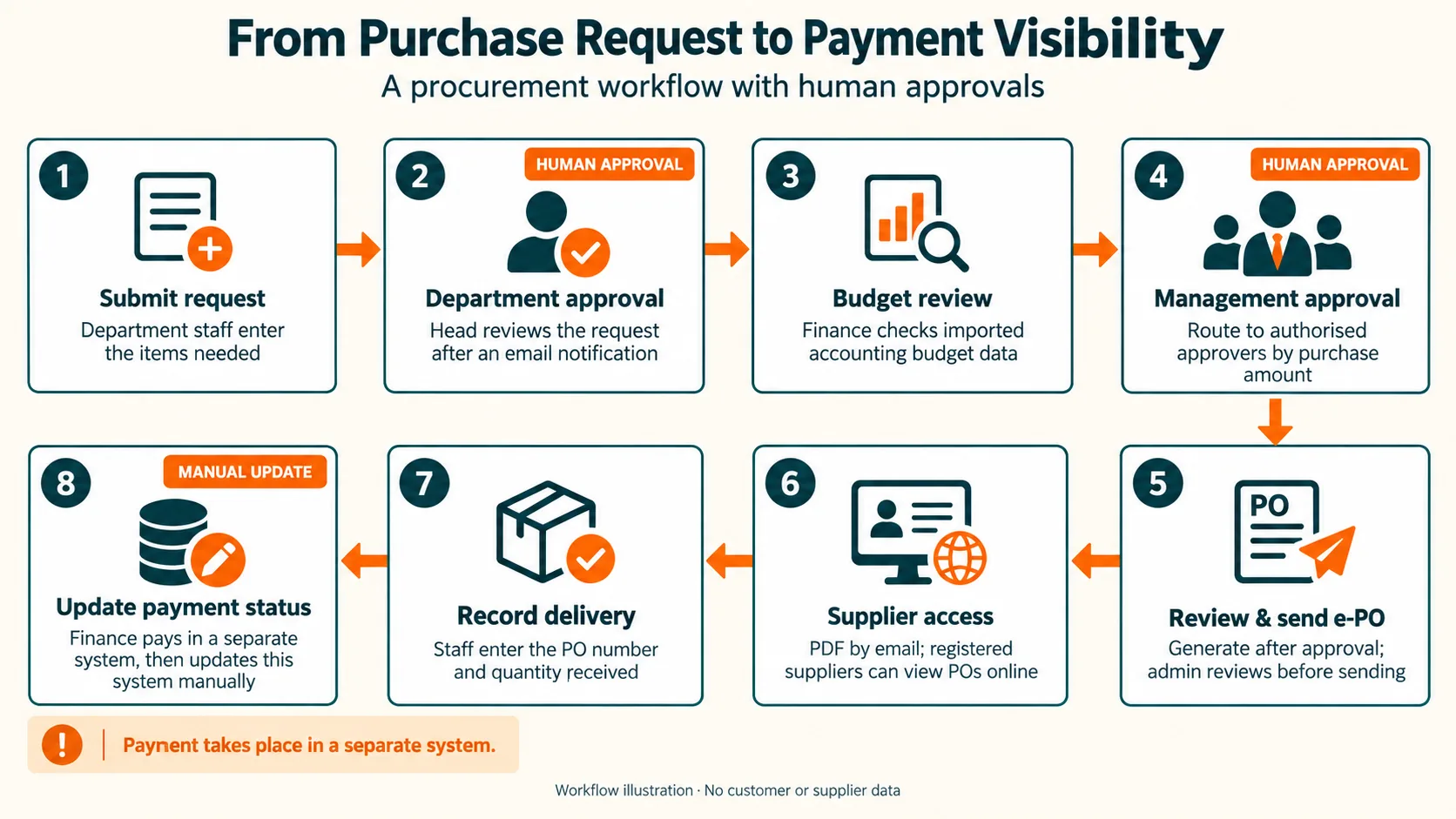
Discuss Your Procurement Workflow

Share how purchasing runs today. We will help identify a practical system for it.