
Budget Control Systems Malaysia

Budget Management System Development

When the accounting books are per company — but the boss needs group budget and cash flow in one view.

GreatRise builds budget management systems that sit above company accounting: summary budget lines management actually uses, live actuals synced from each company's books, and budget-checked approvals — without forcing accountants into painful account-code mapping.

Why Accounting Budgets Often Fall Short

Accounting systems work company by company. The boss wants group cash-flow and budget — one picture across subsidiaries.

Each company often uses different account codes for the same spending idea, so grouping for management is messy or wrong.

Mapping codes in the accounting package is usually hardcoding or deep configuration that accountants find painful and fragile.

Even for one company, the system report format is not the format the boss or the bank wants — so finance re-plots figures in Excel every month.

By the time the re-plot is done, the numbers are already stale and nobody trusts the remaining balance when approving spend.

What a Separate Budget System Changes

A budget system is not a second set of books. It is the management layer: the lines leadership and banks care about, fed by actuals from accounting, without turning every accountant into a report builder.

Group and company budget views — cash flow and utilisation in the format management needs.
Summary budget codes (for example EQ-1 Equipment) that roll up spend from any company account.
Live actual vs budget without monthly re-plotting in Excel.
Commitments and balances that procurement and claims can check before approval.
Accountants keep posting detail in accounting; the budget system only needs the shared code and the amount.
Variance and remaining balance that stay honest as transactions sync.

Budget Control in Practice

Group Cash Flow vs Company Books

Before: Each company closes its own accounts. Finance merges them by hand into a group cash-flow sheet for the boss.
After: The budget system holds the group structure. Actuals sync from each company; management sees one live view.
Impact: Group position without the monthly merge project.

Budget Code EQ-1 Across Different Account Codes

Before: Company A books equipment under one account, Company B under another. Grouping needs spreadsheets or brittle mapping tables.
After: Staff tag the posting with budget code EQ-1. Detail (size, location, notes) stays in accounting. Budget only tracks EQ-1 actual vs budget.
Impact: One management line — many company charts of accounts.

Boss or Bank Format Without Re-Plotting

Before: Accounting export does not match the board pack or bank schedule. Accounts re-type or re-map columns every period.
After: Budget lines and reports are designed to the management and bank layout from day one, filled by sync.
Impact: Reports in the format people actually use.

Why Most Accounting System Budgets Are Not Enough

Accounting software is built to get each company's books right: chart of accounts, postings, statutory reports. That is necessary — and still not enough for how many Malaysian groups and multi-unit organisations manage money.

The boss usually wants group cash flow and budget: what was planned for equipment, projects, or departments across companies, and how much is left. The bank may want a schedule in a fixed layout. None of that is the same job as posting a journal in Company A.

When each company has different account codes for the same idea, grouping inside the accounting package becomes hardcoding or configuration only one person understands. Accountants find that troublesome. When the format still does not match management or the bank, the accounts team ends up plotting the report themselves — again and again.

That is when a separate budget management system earns its place: a layer on top of the companies, not a replacement for accounting.

How We Structure Budget Codes (Example: EQ-1)

In systems we have built, the budget side shows summary lines people manage against — for example Equipment as EQ-1. Users on the budget system care about planned amount, actual, remaining, and whether a new request still fits.

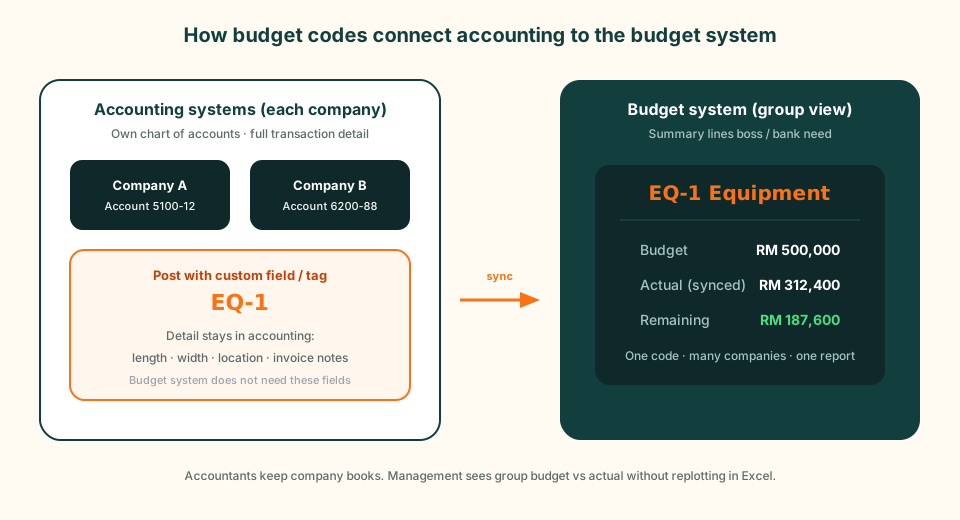
When staff post in any company's accounting system, they enter the usual detail for that company's books. A custom field or tag carries the budget code — EQ-1. Extra detail such as length, width, location, or asset notes stays in accounting. The budget system does not need those fields and does not try to become a second fixed-asset register.

Sync then pulls amounts tagged EQ-1 from each company into the budget line. Management sees EQ-1 actual versus budget across the group. Accountants keep working in familiar company accounts. Nobody forces every subsidiary onto one identical chart of accounts just to produce a group budget.

Diagram: Company A and Company B post with budget code EQ-1 in accounting; the budget system shows EQ-1 Equipment budget, actual, and remaining after sync.
Accounting keeps company detail. The budget system tracks summary codes such as EQ-1 — actual vs budget after sync.

What a Budget Management System Covers

Group and company budget structures for cash flow and control
Summary budget codes that map many account codes to one management line
Budget planning and submission workflows
Commitment and actual tracking (reserved vs posted)
Approval rules tied to available balance
Sync from accounting (and procurement) without double entry of every detail
Reports in the format management and banks need
Budget transfers and revisions with full history
Variance and utilisation reporting

Budget-to-Live-API Systems

A budget system becomes far more useful when other applications can query it. GreatRise has developed budget-to-live-API systems: the budget module exposes live balances through an API, so procurement, claims, and project systems check funds availability in real time before allowing a request to proceed.

This is how budget control stops being a monthly re-plot and becomes part of every transaction — while actuals still flow from accounting on the shared budget codes.

Relevant Project Experience

Budget management is one of our core custom development areas. We deliver it as a management layer on top of company accounting — and often together with e-procurement so purchase requests check live budget before approval.

We do not publish client names or confidential details. Relevant references are shared during consultation where permitted.

Group Budget Layer Above Multi-Company Accounting

Customer situation

An organisation ran several companies, each with its own accounting books and chart of accounts. Leadership needed group cash-flow and budget control — not only statutory company reports.

Existing problem

Accounting budgets could not produce a clean group view. Different companies used different account codes for the same spending categories. Configuration and hardcoding to force grouping was fragile and hard for accountants to maintain. Finance still re-plotted figures into the format the boss and bank wanted.

GreatRise solution

GreatRise built a separate budget management system with summary budget codes. Staff continued posting in each company's accounting system, tagging transactions with the shared code (for example EQ-1). Detail stayed in accounting; the budget system synced amounts and showed actual versus budget on the management lines.

BeforePer-company accounts onlyDifferent codes per companyExcel group re-plotStale remaining balance
AfterGroup budget linesShared codes e.g. EQ-1Synced actualsLive remaining

Key functions

Group and company budget viewsShared budget codes across companiesActual sync from company accountingBudget vs actual vs remainingReports shaped for management and bank needs

Integration: Accounting remains the book of record per company. Budget codes on postings (custom field / tag) drive the sync. Optional live API for procurement to check remaining balance before approval.

Business result

  • Connected previously separate company books into one budget picture
  • Reduced repeated re-plotting for management and bank formats
  • Improved visibility for management
  • Centralised the budget control workflow

Budget Checked at Purchase Request Time

Customer situation

A local organisation needed departmental budgets and purchasing in one controlled process.

Existing problem

Purchase requests moved without a live view of remaining budget. Overspending was discovered after commitments were already made.

GreatRise solution

GreatRise designed the budget structure, live balance tracking, and approval rules together with the procurement workflow so every request checked the budget at approval time.

BeforeRequest without budget viewMonth-end surpriseFiles and email
AfterOnline requestBudget check firstSearchable history

Key functions

Departmental budgetsCommitment on approvalLive balance at request timeVariance reportingProcurement integration

Integration: Budget-to-live-API style checks from procurement; actuals reconciled as spend posts through the linked processes.

Business result

  • Connected budget control to every request
  • Created a complete approval history
  • Improved visibility for management
  • Centralised the procurement and budget workflow

Still re-plotting group budget from company accounts?

Show us one company chart of accounts and the boss or bank format you need. We will sketch the budget-code layer that sits in between.

Discuss Your Business Problem

Systems We Connect Budgets To

Company accounting systems (incl. Biztrak)E-procurement systemsClaims and payment workflowsProject management systemsREST APIs (budget-to-live-API)SQL databasesExcel imports for opening budgets

Governance, Access, and Audit

Keep control of your data and comply with internal governance. We can deploy in your environment with clear retention and access rules.

Department and company-level visibility by role.
Approval and revision history on every budget line.
Role-based control over transfers and revisions.
Cloud or on-premise deployment to match governance requirements.

How We Deliver a Budget System

01

Understand

Map company books, group budget lines, boss/bank report format, and how account codes differ today.

02

Design

Budget code structure, sync rules, commitment logic, and who sees what.

03

Build & Integrate

Build the budget layer and connect accounting, procurement, and reporting.

04

Deploy & Support

Load opening budgets, train finance and users, go live, then support and improve.

A Kuching Team With Long-Term Experience

We are based in Kuching, Sarawak. Projects are delivered with clear documentation, training, and ongoing support.

Since 2009
Delivering business systems from Kuching, Sarawak since 2009.
Cross-Industry Experience
Government-linked, healthcare, education, membership, retail, and corporate projects.
Local, Long-Term Support
Onsite delivery in Sarawak with English, Malay, and Chinese support.

Budget Management System FAQ

Why not just use the budget module in our accounting system?

Accounting budgets are strong for one company's chart of accounts. They struggle when the boss needs group cash flow, when companies use different codes for the same idea, or when the report format must match a board pack or bank schedule. A separate budget layer keeps accounting as the books and gives management the view it actually uses.

How do different company account codes roll into one budget line?

We use shared budget codes (for example EQ-1 for equipment). Staff tag postings in each company with that code. Detail stays in accounting. The budget system sums amounts on EQ-1 for actual versus budget — without forcing every company onto identical account numbers.

Does the budget system replace our accounting software?

No. Accounting remains the book of record per company. The budget system is the management control and reporting layer on top, synced for actuals and often linked to procurement for commitments.

Can approvals be blocked when a budget is exceeded?

Yes. Depending on your policy, the system can block over-budget requests outright, allow them with a flagged justification, or route them to a higher approver.

What is a budget-to-live-API system?

A budget system that exposes live balances through an API, so other applications — procurement, claims, projects — can check funds availability in real time before allowing a transaction.

Does it track commitments or only actual spending?

Both. Budget is reserved when a request is approved (commitment) and reconciled when the expense is actually posted, so the remaining balance is always honest.

Can reports match the format our bank or board wants?

Yes. We design budget lines and export layouts from the formats you already re-plot today, so finance is not rebuilding the same sheet every month.

How do we start?

Bring one company chart of accounts, a sample group or bank budget pack, and any Excel re-plot you still use. We map the budget codes and sync approach, then propose a phased quotation.

Discuss Your Budget Workflow

Share how group and company budgets run today — including where Excel still does the grouping. We will propose a practical system.