
Inventory Management Systems for Malaysian Businesses
Before you buy anything, work out whether the stock module in your accounting system already covers it. Often it does. Sometimes it cannot.
Compare your existing accounting stock module, a dedicated inventory product, and a custom build. Our Kuching team helps define the stock movements, location controls, and accounting connections your business needs.
Where Stock Control Usually Breaks
The balance on the system and the count on the shelf disagree, and the gap only surfaces at year end.
Reordering happens when somebody notices a gap, so you are either out of stock or overbought.
Stock sits across two branches and a consignment location, and only one of them is in the system.
Finance needs a valuation figure and rebuilds it by hand every month from movement reports.
Batch or expiry matters for what you sell, and it is currently tracked on a clipboard.
What a Stock System Changes
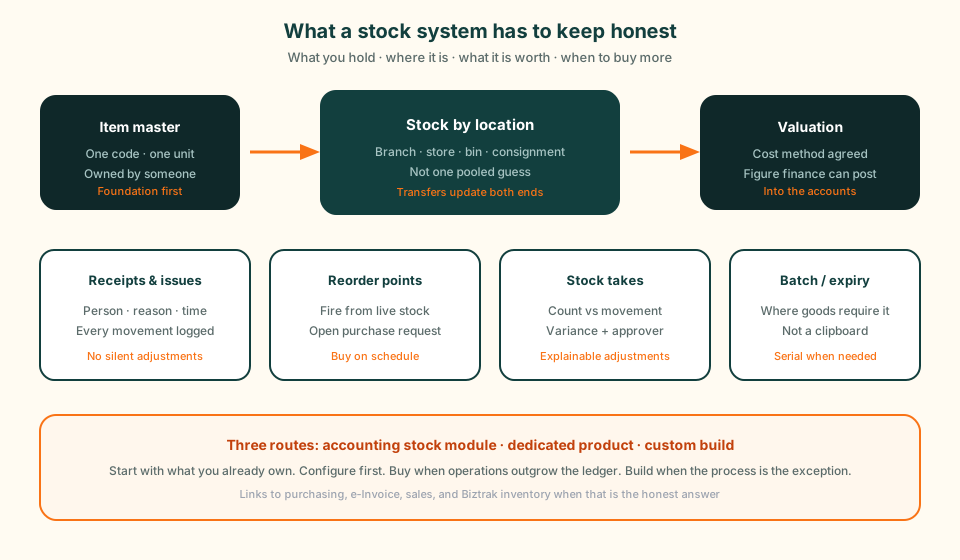
The whole job is knowing what you hold, what it is worth, and when to buy more — accurately enough that nobody keeps a private spreadsheet as a second opinion. Everything below serves one of those three.
Stock Workflows in Practice
Reordering Before the Shortage
Stock Take Without the Shutdown
Stock in More Than One Place
Compare Three Routes for Your Stock System
First check which inventory features and licences your accounting system already includes. A stock module may cover your needs; confirm how it handles your locations, units, stock adjustments, and valuation before adding another system.
Bring a sample item list, recent stock movements, and your branch or warehouse structure. We can compare the gaps against Biztrak, a dedicated product, or a custom scope connected to your existing accounts.
| Route | What it handles well | Where it runs out | Cost shape |
|---|---|---|---|
| Your accounting system's stock module | Item records, quantities, valuation, and purchase and sales links, depending on your edition. | Check support for locations, bins, batch and expiry rules, and warehouse access. | Check your existing licence and any module or implementation fees. |
| A dedicated stock product | Stock operations such as scanning, locations, and stock takes; confirm the features in a demo. | Check connectors, data ownership, and whether the product supports your actual process. | Request a quote covering users, sites, connectors, and setup. |
| A custom build | Your process exactly, including the parts no product models, and integration into systems with no public API. | Speed and cost of entry. It cannot beat a configuration to go-live, and it should not try. | Quoted in phases. The asset is yours. |
What a Stock System Has to Do
The functions below are the ones that decide whether the recorded balance can be trusted. If a route you are considering is weak on more than two of them, that is your answer.
Where Stock Data Has to Reach
Stock figures are only useful where decisions get made, which is rarely the stock screen itself. Finance needs valuation, purchasing needs demand, and sales need availability. A system that holds all three hostage in one place just creates reconciliation work.
The connections that matter in Malaysian projects are accounting, purchasing, e-invoicing, and whatever is already running the sales side. We treat these as system and API integration work regardless of which of the three routes you take.
Accounting
Valuation and cost of sales posting to the accounts rather than being rebuilt by hand each month. We implement Biztrak, which carries an inventory module, and integrate with other accounting systems.
Purchasing
Reorder points that open a real purchase request, so buying follows demand instead of a verbal shortage. This is where an e-procurement system and stock control meet.
e-Invoice / MyInvois
Stock that becomes a sale has to reach the LHDN e-Invoice submission with the right line detail. Confirm your own current obligations at the LHDN source before scoping — the requirements have moved more than once.
Sales and order systems
Availability visible where orders are taken, and despatch writing back so the balance does not lag the day's trading.
Relevant Project Experience
Where the experience actually sits, stated plainly: GreatRise has delivered the purchasing, approval, and integration systems that surround stock rather than a dedicated stock-floor product. That is adjacent work, not the same work, and you should know the difference before briefing us.
What we have built and run in production: procurement systems carrying delivery and goods-received tracking against the purchase order, vendor and quotation records, approval workflows with a complete action log, live budget and commitment checking, and system-to-system API integration keeping separate systems in step. We also implement Biztrak, an accounting platform with an inventory module, for Malaysian SMEs — which is frequently the honest answer to this search.
Client names and confidential details are not published. Where permitted, relevant references are shared during consultation so you can judge fit without another organisation's data being exposed.
Purchase requests, live budget checks, approvals, and goods-received tracking — the buying side of stock control.
When the problem is floor operations — put-away, picking, cycle counts — rather than the stock ledger.
Anonymised systems GreatRise has designed and delivered since 2009, grouped by industry.
What It Costs and How Long It Takes
Focused automation and workflow work is priced as fixed-scope sprints, typically RM 8,000–15,000 for a 2–3 week implementation. A full operational system is quoted in phases, because the cost is driven by how many locations, roles, integrations, and approval paths are involved rather than by screen count. After a consultation we provide a fixed written quotation, so you know the investment before development starts and the number does not move unless you change the scope.
When you compare that against a subscription, compare properly. Take the monthly figure out five years, add per-user growth, and add the cost of the workarounds you will run for whatever the product does not cover. Sometimes the subscription still wins clearly — and if it does for you, we would rather say so than sell you a build.
On sequencing: prove one site and one product group for a month before extending. It surfaces the awkward parts of your item master while fixing them is still cheap, and an item master nobody owns will defeat any of the three routes.
When You Should Not Build Custom
These are the disqualifiers we apply before quoting. If two or more describe you, take one of the other two routes — and we will say so on the call rather than write you a proposal.
Not sure which of the three routes you need?
Tell us what your accounting system already does. That answer usually settles it in one call.
What We Connect Stock Systems To
Access, Control, and Deployment
Keep control of your data and comply with internal governance. We can deploy in your environment with clear retention and access rules.
How We Deliver a Stock System
Assess
Review what your accounting system already does, and establish which of the three routes fits before quoting anything.
Design
Item master rules, locations, approval thresholds, reorder logic, and the integration plan agreed in writing.
Build & Integrate
Develop or configure, then connect accounting, purchasing, and sales so figures stay in step.
Pilot & Roll Out
One site and one product group first, then extend, with training and long-term support.
A Kuching Team With Long-Term Experience
We are based in Kuching, Sarawak. Projects are delivered with clear documentation, training, and ongoing support.
Related Services
Receiving, put-away, picking, and cycle counts on the floor.
Purchase requests, approvals, and goods-received tracking.
Full operational systems built around how you work.
When the stock file is a spreadsheet that has outgrown one editor.
Inventory Management System FAQ
Software that holds one authoritative record of what stock you have, where it is, what it cost, and every movement in and out. The functions that matter are the item master, stock on hand by location, receipts and issues attributed to a person, reorder points, batch and expiry where relevant, stock take reconciliation, and a valuation figure finance can post to the accounts.
Very often, yes — and it is the first thing to check because you have already paid for it. Accounting stock modules handle the item master, quantity on hand, costing, and the purchase and sales links well. They run out when you need multi-location detail, bin-level movement, batch or expiry rules, or operational work happening away from the accounting screen. Set up what you own properly before buying anything else.
Buy, in most cases. A configured product has you running in weeks, the cost is predictable, and the vendor maintains it. Build when your process is genuinely unusual, when the system has to reach into something the product cannot connect to, or when the way you handle stock is part of what makes you competitive. We will tell you which case you are in before writing a proposal.
Focused automation and workflow work is priced as fixed-scope sprints, typically RM 8,000–15,000 for a 2–3 week implementation. A full operational system is quoted in phases, because the cost follows the number of locations, roles, integrations, and approval paths rather than the number of screens. You get a fixed written quotation after a consultation, and it does not move unless the scope does.
Yes, and it should be designed in from the start rather than added later. Each location holds its own balance, transfers record both ends of the move, and reporting rolls up to the group while each site still sees its own position. Consignment and customer-held stock are worth naming at scoping, because they are usually the locations that get left out.
Yes where the goods require it — food, pharmaceutical, chemical, and electronics operations usually do. Flag it early, because batch and expiry rules change how issuing and valuation work rather than simply adding a field to a form.
Yes. Valuation and cost of sales belong in the accounts rather than in a second set of figures to reconcile each month. We implement Biztrak, which carries an inventory module, and integrate with other accounting and ERP systems through APIs, database connections, or file exchange where no API exists.
Yes, and this is usually where the return comes from. A threshold breach opens a purchase request with the item, quantity, and usual supplier already attached, so buying follows real demand rather than a verbal shortage. Where the approval and budget side also matters, that connects to a full e-procurement system.
Yes. Scanning at receipt, issue, and stock take is usually where the accuracy gain comes from, because it removes the retyping step where most errors originate. Which scanners and label formats you already have is worth raising at scoping, since it shapes the design.
Both. GreatRise implements established business platforms such as Biztrak for Malaysian organisations and builds custom systems where a product does not fit. That is why the comparison on this page recommends configuring what you already own first — we deliver every one of the three answers, so the recommendation follows your operation rather than our catalogue.
Request a Custom System Assessment
We will look at what you already own first, then tell you straight whether to configure, buy, or build.