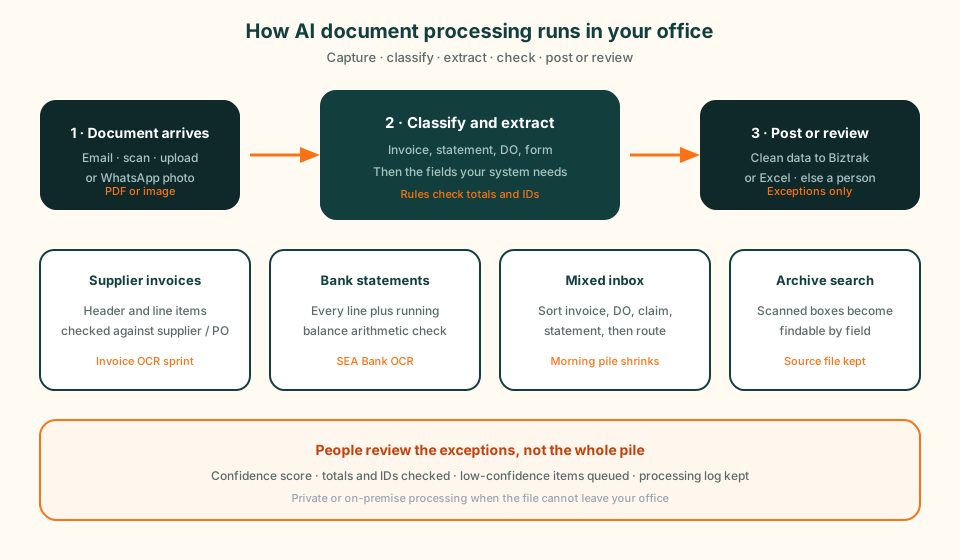
What is AI document processing?
A pipeline that classifies an incoming file, extracts the fields the next system needs, checks them against your rules, and posts a clean record. People review only the items the pipeline will not stand behind. The source file stays with the extracted record so you can open what was read.
How is this different from plain OCR?
OCR turns an image into text. AI document processing names the document type, picks the values that matter, and checks whether those values are consistent. The classification, the rule checks, and the posting step are what stop someone from interpreting a raw text dump.
Which documents should we automate first?
The pile your team retypes most often. For most Malaysian finance teams that is supplier invoices or bank statements. We look at volume and the cost of a wrong figure during the audit, then start with one type so the review queue stays small at launch.
Can it handle Malay and Chinese documents?
Yes. Many Malaysian files mix English, Malay, and Chinese on the same page. We test extraction on your real samples before go-live. SEA Bank OCR already handles mixed-language bank statements in production.
What about sensitive documents and PDPA?
Processing can run on private or on-premise infrastructure, with role-based access, processing logs, and agreed retention. Model calls, integrations, logs, backups, and support access also need review to keep the complete workflow private. PDPA compliance depends on the full process and controls, not local hosting alone.
What document processing have you already delivered?
We operate SEA Bank OCR, a live converter for Malaysian bank statements covering 11 or more banks, with running-balance checks and Excel, CSV, or JSON export. We also implement invoice pipelines that extract supplier files and post drafts into Biztrak. We do not publish client names; references are shared in a meeting when the client allows it.
How much does AI document processing cost in Malaysia?
A fixed-scope sprint is typically RM 8,000-15,000 for one document type and one landing system: audit, extraction, rule checks, review queue, connection, and training. SEA Bank OCR is separate and self-serve, from a free 5-page starter plan to paid plans from RM99 a month. Model usage, if any, is billed by the provider.
Can extracted data go into Biztrak?
Yes. We are an authorised Biztrak partner. Validated invoice data and extracted bank lines can land as drafts in the accounting workflow rather than as another spreadsheet. MyInvois submission stays on the accounting system; the pipeline removes the retyping in front of it.
What happens when the pipeline does not trust the extraction?
The file goes to a person with the extracted values filled in. Staff confirm or correct. Nothing guessed is posted. The log records the confidence, the failed rule, and who accepted the correction.
Do I need this page or a single-document build?
If the pile is only supplier invoices, use the invoice page. If the pile is only bank statements, use the statement page or SEA Bank OCR. Use this page when the inbox is mixed, when you need classification first, or when the same pipeline has to grow from one type to several.
Do we have to replace our accounting system?
No. The point of the sprint is to feed the system you already run. We connect to Biztrak, Excel, a database, or an API. Replacing the ledger is a different project, and we will say so if that is what you actually need.