
Warehouse Management Systems Built Around Your Operation
Receiving, put-away, picking, stock movement, and counts — shaped to how your warehouse actually runs rather than to a product's assumptions.
GreatRise builds custom warehouse systems for Malaysian operations from Kuching, and implements off-the-shelf platforms when that is the better answer. This page is the honest version of that decision, including the cases where you should not build.
Where Warehouse Operations Usually Break
The figure on the system and the stock on the rack stopped agreeing months ago, and nobody fully trusts either one.
Picking runs off a printed list, so a mis-pick only surfaces when the customer calls.
The off-the-shelf system fits most of the process, and the rest runs on WhatsApp, a whiteboard, and one person's memory.
Goods arrive without paperwork that matches the purchase order, and the reconciliation waits until month end.
Scanners, label printers, and the accounting system each expect a different format, so someone retypes between them.
What a Warehouse System Changes
A warehouse system earns its place by keeping the recorded position and the physical one in agreement, continuously, without anyone shutting the operation down to check. Most of the rest follows from that.
Warehouse Workflows in Practice
Receiving Against the Purchase Order
Put-Away and Finding It Again
Cycle Counts Instead of the Annual Shutdown
Off-the-Shelf WMS or a Custom Build: The Honest Comparison
Almost everything written about this decision is published by someone selling one of the two answers. Here is ours, with the bias declared: GreatRise builds custom systems and also implements off-the-shelf business platforms, so we have no structural reason to push you either way.
The short version is that most warehouses should buy. A configured product has you running in weeks, the subscription is predictable, and the vendor absorbs the maintenance. A build earns its cost when the way you handle goods is genuinely unusual, when the system has to reach into something a product cannot connect to, or when the process that makes you competitive is exactly the part a product would force you to abandon.
| What you are weighing | Off-the-shelf WMS | A custom build |
|---|---|---|
| Time to first use | Weeks. Configure, load the item master, train, go. | Longer. The process has to be mapped before anything is written. |
| Cost shape | Lower to begin, then a per-user or per-site subscription that does not stop. | Higher at the start, then hosting and support. The asset is yours. |
| Process fit | Strong where your process is conventional. You adapt to the product. | Built to your process, including the parts that make you competitive. |
| Integration ceiling | Whatever the vendor exposes. If a connector does not exist, it does not exist. | Whatever your systems can be made to talk to, including old ones with no public API. |
| Changing it later | Wait for the vendor roadmap, or pay for customisation on top of the subscription. | Change it when the operation changes. It is your code. |
| Who supports it in three years | The vendor, at whatever the renewal price is by then. | Whoever holds the source. Ask that question before you sign, either way. |
| Honest verdict | The right answer for most warehouses, most of the time. | The right answer when the exceptions are the business. |
What a Warehouse Management System Has to Do
Strip away the marketing and the job is narrow: know what is in the building, know where it is, and know it without anyone walking the racks to confirm. Every function below exists to protect one of those three.
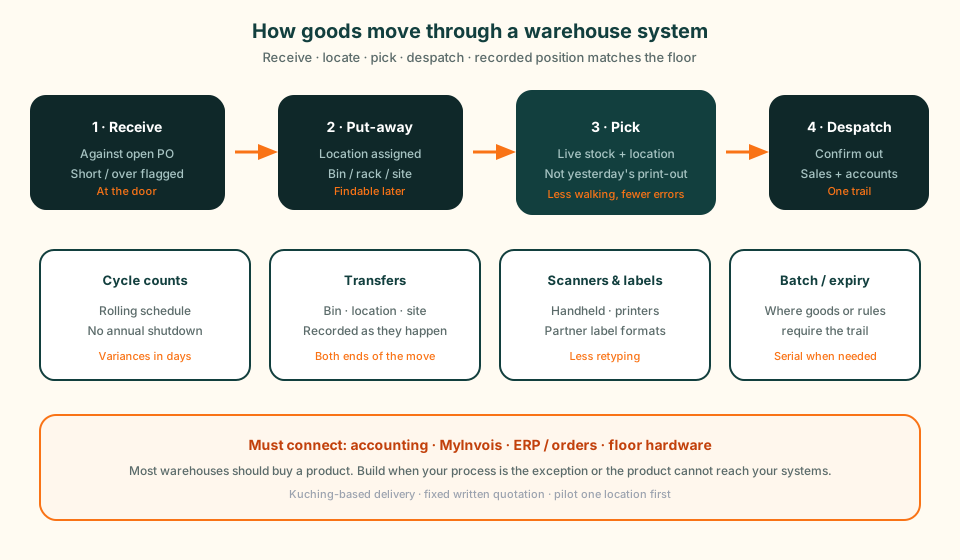
Where a Warehouse System Has to Connect
A warehouse system that cannot reach the rest of the business just creates a second set of numbers to reconcile. In practice the integration work is often a larger share of the project than the warehouse screens are, and it is where off-the-shelf products most often hit their ceiling.
Four connections come up in nearly every Malaysian project: accounting, e-invoicing, whatever ERP or order system already exists, and the hardware on the floor. We handle these as system and API integration work whether the warehouse side is a product or a build.
Accounting
Goods received, stock valuation, and cost of sales landing in the accounting system rather than a spreadsheet. We implement Biztrak, which carries an inventory module, and integrate with whatever else is already in place.
e-Invoice / MyInvois
Goods movement that becomes a sale has to reach the LHDN e-Invoice submission with the right line detail. Confirm your own current obligations at the LHDN source before scoping, since the requirements have moved more than once.
Existing ERP or order system
Sales orders in, despatch confirmations out. Older systems without a public API usually still expose a database or a file drop we can work with.
Barcode and scanner hardware
Handheld scanners, label printers, and the label formats your customers or third-party logistics partners insist on.
Relevant Project Experience
Straight answer, because it matters more than a logo wall: the systems GreatRise has delivered in this area are the goods-and-approval side rather than a full warehouse floor system. That work is directly adjacent, and you should know exactly where the experience sits before you brief us.
What we have built and run in production: procurement systems carrying delivery and goods-received tracking against the purchase order, vendor records and quotation history, approval workflows with a complete action log, live budget and commitment checking, and system-to-system API integration that keeps separate systems in step. We also implement Biztrak, an accounting platform with an inventory module, for Malaysian SMEs.
Client names and confidential details are not published. Where permitted, relevant references are shared during consultation so you can judge fit without another organisation's data being exposed.
Purchase requests, approvals, and goods-received tracking — the process immediately upstream of receiving.
Anonymised systems GreatRise has designed and delivered since 2009, grouped by industry.
How we scope, build, and support operational systems beyond the warehouse.
What It Costs and How Long It Takes
Focused automation and workflow work is priced as fixed-scope sprints, typically RM 8,000–15,000 for a 2–3 week implementation. A full operational system is quoted in phases, because the cost is driven by how many locations, roles, integrations, and approval paths are involved rather than by screen count. After a consultation we provide a fixed written quotation, so you know the investment before development starts and the number does not move unless you change the scope.
For comparison rather than as our price: off-the-shelf platforms in this market are overwhelmingly quote-on-request, and the few that publish figures do so as a monthly subscription per user or per site. When you compare, put both on the same footing — take the subscription out five years, and add the cost of the workarounds you will run for the parts it does not cover.
On sequencing, what works is piloting one location or one product group first. It surfaces the awkward parts of your process while changes are still cheap, and it gives floor staff a working system to react to instead of a specification to imagine.
When You Should Not Build Custom
These are the disqualifiers we apply before quoting. If two or more of them describe you, buy a product — and we will say so on the call rather than write you a proposal.
Not sure whether you should build or buy?
Walk us through how goods move today. If a product fits, we will tell you which kind to look at.
Systems a Warehouse Has to Talk To
Access, Control, and Deployment
Keep control of your data and comply with internal governance. We can deploy in your environment with clear retention and access rules.
How We Deliver a Warehouse System
Assess
Walk the floor, map how goods actually move, and establish whether a product would serve you better.
Design
Locations, item master rules, scanning points, and the integration plan agreed in writing.
Build & Integrate
Develop the system and connect accounting, ERP, and floor hardware.
Pilot & Roll Out
One location or product group first, then extend, with training and long-term support.
A Kuching Team With Long-Term Experience
We are based in Kuching, Sarawak. Projects are delivered with clear documentation, training, and ongoing support.
Related Services
Stock levels, reorder points, and batch or expiry tracking across locations.
Purchase requests, approvals, and goods-received tracking.
Full operational systems built around how you work.
Approval workflows and integration beyond the warehouse.
Warehouse Management System FAQ
Software that tracks what is in a warehouse, where it is, and every movement in and out — receiving against the purchase order, put-away to a location, picking, transfers, cycle counts, and despatch. The point of it is that the recorded position matches the physical one continuously, so nobody has to shut the floor down to find out what is really there.
Buy, in most cases. A configured product has you running in weeks, the cost is predictable, and the vendor maintains it. Build when the way you handle goods is genuinely unusual, when the system must connect to something the product cannot reach, or when the process that makes you competitive is exactly what a product would force you to give up. We will tell you which case you are in before writing a proposal.
Focused automation and workflow work is priced as fixed-scope sprints, typically RM 8,000–15,000 for a 2–3 week implementation. A full warehouse system is quoted in phases, because the cost follows the number of locations, roles, integrations, and approval paths rather than the number of screens. You get a fixed written quotation after a consultation, and it does not move unless the scope does.
Longer than configuring a product, which is part of the honest comparison. We normally pilot one location or one product group first, so the operation sees something working early and the awkward parts of the process surface while changes are still cheap, then extend from there.
Yes, and it should. Goods received, stock valuation, and cost of sales belong in the accounting system rather than in a second set of numbers to reconcile. We implement Biztrak, which carries an inventory module, and integrate with other accounting and ERP systems through APIs, database connections, or file exchange where no API exists.
Yes. Handheld scanners at receiving, put-away, and picking are usually where the accuracy gain comes from. Label formats are worth raising early, because customers and third-party logistics partners often dictate them, and that constraint shapes the design.
Yes. Multi-location is a design decision made at the start rather than an add-on later: stock held by location, transfers between sites with both ends recorded, and reporting that rolls up to the group while each site still sees its own position.
Supported where the goods require it — food, pharmaceutical, chemical, and electronics operations usually do. Flag it at scoping, because batch and expiry rules change how picking and valuation work rather than simply adding a field.
It has to be designed for rather than discovered. Depending on the operation that means scanners queueing transactions locally and syncing when the connection returns, an on-premise deployment, or a documented paper fallback that reconciles cleanly afterwards. We agree which approach applies during design.
Both. GreatRise implements established business platforms such as Biztrak for Malaysian organisations and builds custom systems where a product does not fit. That is why the comparison on this page is not a pitch for one side — we deliver either answer, so the recommendation follows your operation rather than our catalogue.
Request a Custom System Assessment
We will map how your warehouse actually runs and give you a straight answer on build versus buy before any proposal.