
From Excel Stock Control to Controlled Stock: A Sarawak Guide
Excel stock sheets hide cost until a shortage, write-off, or audit. A stock system with issue approval, alerts, and procurement links gives finance a single source of truth.
Moving to an inventory management system replaces the shared Excel stock file with one record for quantity on hand, who issued or received stock, and who approved exceptions. For owners and finance leads in Sarawak and Kuching, the practical gains are fewer surprise shortages, cleaner write-offs, and a purchase trail that matches real stock movements. This guide covers the migration itself; if you are still deciding between a product and a build, start with the comparison on that page.
This short guide is for business owners and finance teams who still run stock on spreadsheets and messages. It shows what changes when you move from Excel stock control to a system with approval and alerts, and how inventory should connect to procurement rather than sit as a separate file.
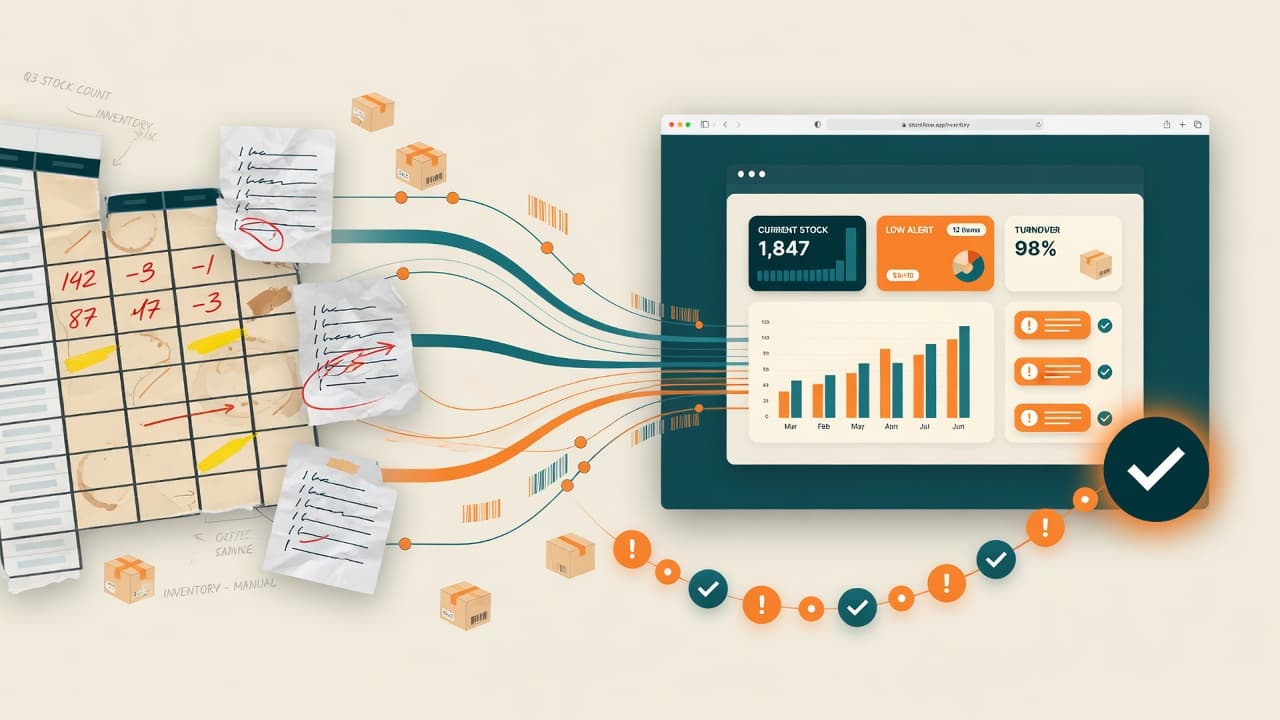
Illustration of messy Excel stock counts transforming into an inventory system with low-stock alerts, charts, and approval checks.
Where Excel Stock Control Breaks for Finance
Excel remains useful for analysis and a one-off stocktake. The problem starts when the same file must answer operational questions all week: current quantity, reserved stock, who took the last carton, and whether a manager approved a write-off. Staff update rows after the fact. Messages carry the real decision. Month end, finance reconciles three versions of the truth.
Owners feel the cost in four places: stockouts that stop sales or projects, excess buy because nobody trusts the balance, slow month-end stock valuation, and audit questions with no named approver on the movement. Those are finance problems first. The warehouse feels them second.
What Changes: Excel Stock to System With Approval and Alerts
A controlled stock system keeps the item master and quantity in one place, then wraps each movement in a form, a role, and a status. The day-to-day difference looks like this:
- Issue and receive: staff submit a request with item, quantity, project or cost centre, and reason. The system records the user and timestamp instead of a cell edit.
- Approval: write-offs, high-value issues, or transfers above a limit go to a named manager or finance role. Rejected requests stay in history with a comment.
- Alerts: low stock, reorder point, and near-expiry (where relevant) notify the owner or store lead before the bin is empty. You set the threshold once; the system watches every balance.
- Visibility: finance opens a live balance and movement history without waiting for the workbook owner to clean formulas after leave.
You can still export a snapshot to Excel for a board pack or pivot analysis. The system remains the source of truth. That is the same pattern used when teams replace an Excel approval process: keep the spreadsheet for analysis, not as the operational ledger.
Why Inventory Should Link to Procurement
Stock without purchasing is half the story. When store staff discover a shortage, they often open a chat or a separate purchase request form. By the time finance sees the PO, the stock file may still show an old balance. Linked inventory and e-procurement close that gap.
A practical flow for Malaysian SMEs and multi-department organisations:
- Stock balance hits the reorder point, or a user submits a stock request the store cannot fulfil.
- The system creates or suggests a purchase request with item codes, quantity, and preferred supplier where known.
- Approvers see remaining budget or policy limits (when budget control is in place) before they commit spend.
- Goods receipt updates the inventory balance and closes the loop against the PO line.
That path matters in Sarawak as much as in Peninsular Malaysia. Branch distance, project sites, and slower restock lead times punish wrong balances. Owners in Kuching who buy for sites in Sibu, Miri, or Bintulu need one view of what left the store and what is already on order.
Minimum Requirements for an Owner-Finance Stock System
Before you pick SaaS, Biztrak inventory, or a custom build, agree on controls. Screens can wait. Rules cannot.
- Item master: SKU, unit, location or bin, cost or valuation method, reorder point.
- Named accounts and roles for store, requester, approver, and finance viewer.
- Movement types: receive, issue, transfer, adjust, write-off, each with required fields.
- Approval matrix for write-offs and high-value issues; optional dual control for adjustments.
- Low-stock and overdue-receipt alerts to a named owner, not a shared inbox alone.
- Searchable history and export for month-end and external audit.
- Clear cutover: one system of record for new movements; old Excel archived read-only.
If the stock process sits next to purchase approval and departmental budgets, a custom workflow or an integrated business process automation build often fits better than a generic list tool. If you already run accounting with inventory, extending that module can be enough for a single warehouse.
First Steps for Sarawak and Kuching Teams
Pick one warehouse or store. List the 50 to 200 items that move most. Capture who issues stock today, who should approve write-offs, and which shortages create the last three emergency purchases. Bring that list and one messy Excel file to a short automation audit. GRITC maps the flow, recommends platform vs custom, and scopes a fixed build when the rules are clear.
Typical focused engagements for this class of workflow run about 2 to 3 weeks at RM 8,000 to RM 15,000 when scope stays on one site, clear roles, and no deep ERP rewrite. Multi-branch barcode, mobile scanning, and live budget APIs expand the plan. Start small, prove balances for one month, then extend.
Give Finance a Stock Balance You Can Defend
A stock system should answer three owner questions without a chase: what is on hand, who moved it, and when do we buy again. Excel can start that journey. It cannot own concurrent issues, named approvals, alerts, and a clean link to procurement once the business grows past one editor.
If your Kuching or Sarawak team still runs stock on a shared file, book a free automation audit. Bring the workbook and one real shortage story. We will show where approval and alerts should sit, and whether procurement should share the same system.
Read Next
- Inventory Management System Malaysia compares off-the-shelf platforms, your accounting system's stock module, and a custom build — including when each one wins.
- How to Replace an Excel Approval System covers routing, reminders, and audit trail for any approval that outgrew a spreadsheet.
- E-Procurement System Malaysia shows purchase request, budget check, and approval through to PO.
- Excel to Web Application explains how a critical workbook becomes a multi-user system.
Frequently Asked Questions
Is Excel enough for inventory management in Malaysia?
Excel works for a small SKU list with one person updating it. Once several people issue stock, branches share items, or auditors ask for who approved a write-off, a stock workbook leaves gaps. A system holds quantity, approval, and history in one place.
What should a stock system include for finance owners?
Named users, stock issue and receive forms, approval by role or value, low-stock and expiry alerts, valuation or cost snapshots, and export for accounts. Link purchase requests so you buy against real demand, not a verbal shortage.
Can inventory link to e-procurement?
Yes. A low-stock alert or approved stock request can open a purchase request with item, quantity, and preferred supplier. Finance sees commitment before the PO, not after goods arrive and the spreadsheet is updated late.
How long does a first inventory system take for a Kuching SME?
A focused stock module for one store or warehouse often fits a 2 to 3 week fixed-scope build when item master, units, and approval rules are clear. Multi-branch, barcode, and ERP links increase scope. Start with a short process audit.
Ready to Replace Excel Stock Control?
Bring the stock workbook and one shortage or write-off example. We map approval rules, alert points, and the procurement link, then scope a fixed-price system.