e-Invoice Malaysia: The 2026 Guide to Exemption, Phases, and MyInvois
On 30 August 2026 LHDN raised the e-Invoice exemption from RM1 million to RM3 million, effective 1 September. LHDN says more than 1.1 million businesses now fall under the exemption. Here is who is in, who is out, and what to do next, checked against LHDN's timeline, e-Invoice FAQ and Specific Guideline on 23 September 2026.
On 30 August 2026 the Inland Revenue Board (LHDN) raised the e-Invoice exemption threshold from RM1 million to RM3 million in annual turnover, effective 1 September 2026 (LHDN media release, in Malay). LHDN says more than 1.1 million businesses benefit. If you read anything about e-Invoice in Malaysia before that date, including our own earlier guide, the threshold it quotes is wrong. This page is the replacement. Every figure on it was checked against the official LHDN implementation timeline, e-Invoice FAQ and Specific Guideline on 23 September 2026, and the timeline page itself carries the date 30 August 2026.
This guide is for owners, finance leads, and admin staff who need a straight answer to three questions: does the mandate apply to me, what exactly do I have to do, and what can I safely ignore. It is written from Kuching, where many small businesses now fall under the exemption, but the rules are national.
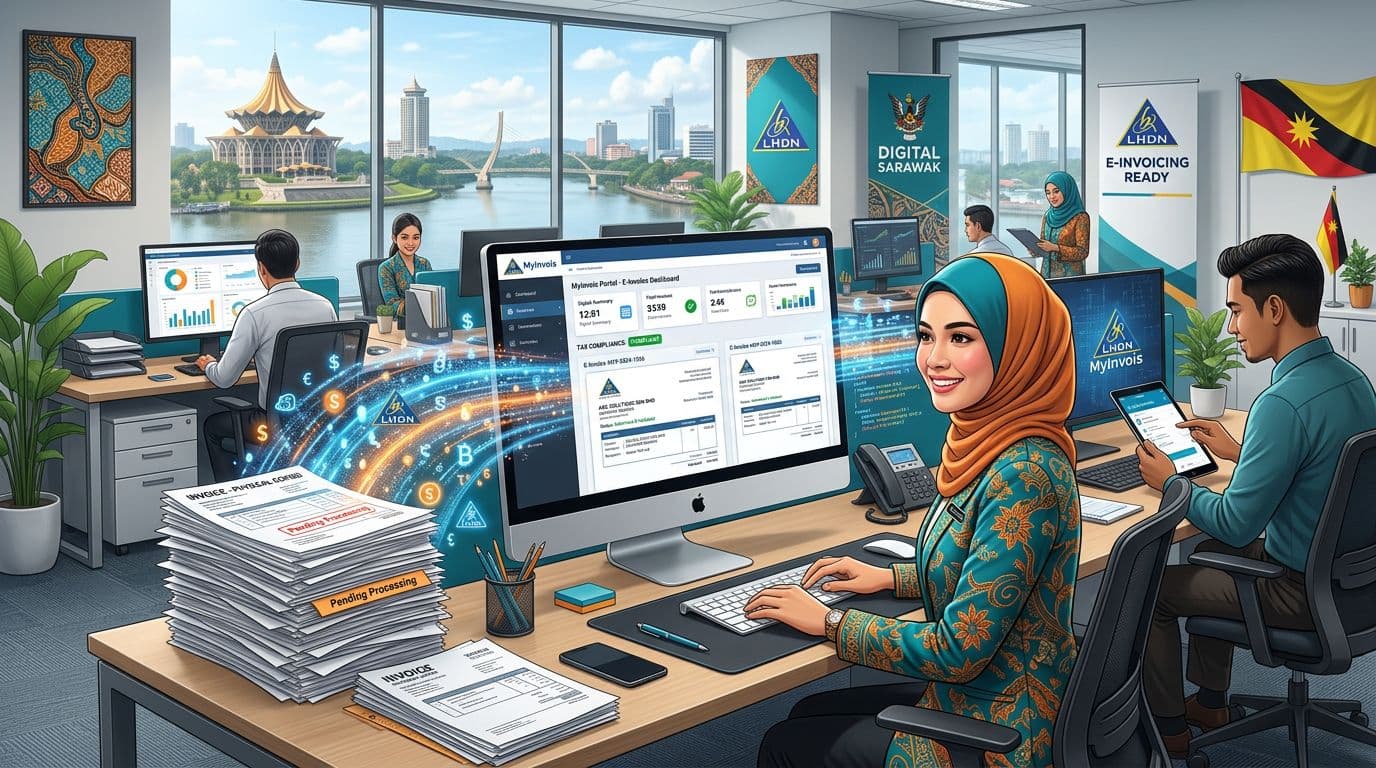
Illustration of a Malaysian business owner checking the LHDN e-Invoice timeline and the RM3 million exemption threshold on MyInvois.
What Changed on 30 August 2026
LHDN published e-Invoice Guideline version 4.8 on 30 August 2026 and updated the implementation timeline the same day. The single change that matters: taxpayers with annual turnover or revenue below RM3,000,000 are exempt from e-Invoice implementation. The previous threshold was RM1,000,000, announced by the Prime Minister and confirmed in LHDN's media release of 31 December 2025, and before that RM500,000. The Star reported LHDN as saying over 1.1 million businesses benefit from the higher threshold.
Nothing else in the schedule moved. The four phases and their dates are the same, and all four have already started. The practical effect is that Phase 4, published as "up to RM5 million", now covers businesses between RM3 million and RM5 million. Businesses that have stayed below that line since YA2022, with no group link, have no e-Invoice deadline.
The rules on this page come from three LHDN documents: the e-Invoice Guideline (version 4.8, published 30 August 2026), which sets the RM3 million exemption; the e-Invoice Specific Guideline (version 4.9, published 7 September 2026), which covers particular transactions, including when a buyer may self-bill and what the relaxation period allows; and the e-Invoice FAQ (updated 4 September 2026), which works through the exemption cases. LHDN revised all three between late August and early September 2026 and revises them often, so download the current versions from the official guidelines page and the FAQ page, and check the version on the cover.
Do You Have to Comply? Work Through It in This Order
Check your position in this sequence. Most businesses stop at the first line.
- Annual turnover below RM3,000,000 in YA2022 and in every year since (or since you started, if later; see LHDN FAQ Q13 and Q14), with no group link (see below): you are exempt. You do not need to issue e-Invoices, buy anything, or change how you invoice. If you sell on a local e-commerce platform, you still give the platform your details so it can issue the e-Invoice (LHDN FAQ Q106).
- Annual turnover of RM3,000,000 or more in any year from YA2022 to YA2025: you are in scope and your date has passed (1 July 2026 at the latest). Issue e-Invoices now through the MyInvois portal or connected software, and compare the free portal, e-Invoice-ready software and API integration on our e-Invoice software options page.
- Part of a group: the exemption does not apply if you have a non-individual shareholder, a holding company, or a related company or joint venture with turnover of RM3 million or more. A small subsidiary of a large group is still in scope.
- Close to the line, or growing: if you first reach RM3 million in YA2026 or later, you start on 1 January of the second year after that year of assessment. Once your date is set, falling back below RM3 million does not restore the exemption (LHDN FAQ Q104). Choose e-Invoice-capable accounting software at your next natural upgrade.
- Exempt but selling to large companies: customers may ask for an e-Invoice, but they cannot compel you to issue one, or self-bill an ordinary sale (LHDN FAQ Q27 and Q107). See the FAQ at the end of this page.
LHDN starts from your 2022 turnover (audited financial statements for financial year 2022 where they exist, otherwise the tax return for YA2022), but 2022 is not the only year that counts. Under LHDN's e-Invoice FAQ (updated 4 September 2026, Q12), a business below RM3 million in YA2022 that reached RM3 million in YA2023, YA2024 or YA2025 implements from 1 July 2026, and one that first reaches RM3 million in YA2026 or later starts on 1 January of the second year after that year. A small business that fails the group test starts on 1 July 2026, or on the day it starts operating if that is later (Q12, Q13 and Q14). Sole proprietors add together every sole proprietorship owned or registered in their name (Q102). Businesses that started operating in YA2023 or later have their own rules (Q13 and Q14).
What e-Invoice Actually Is
e-Invoice, or e-Invois in Bahasa Malaysia, is not a PDF sent by email. It is a structured document, in XML or JSON, submitted to LHDN through the MyInvois system and validated in near real time. The sequence for every document is the same:
- You create the invoice in the MyInvois portal, or your software creates it and submits through the MyInvois API.
- LHDN validates the mandatory fields, around 55 of them, including your TIN, business registration number, MSIC code, the buyer's TIN, and item classification codes.
- A validated document receives a unique identifier number (UIN), a validation timestamp, and a QR code. This is the proof that the invoice exists in LHDN's records.
- You share the validated invoice with your buyer, usually as a PDF or printout carrying the QR code, so they can verify it.
- The buyer has 72 hours from validation to reject it, and you have 72 hours to cancel it. After that, corrections need a credit note, debit note, or refund note, which are themselves e-Invoices.
The document types in scope are invoices, credit notes, debit notes, refund notes, and self-billed versions of each. A buyer may issue a self-billed e-Invoice only in the cases listed in Section 8.3 of the e-Invoice Specific Guideline, for example payments to agents and dealers, purchases from foreign suppliers, and transactions with individuals who are not in business. A normal sale by an exempt Malaysian supplier is not one of those cases (LHDN FAQ Q27; Specific Guideline Example 13), but commission paid to an exempt agent or dealer still is.
The Four Phases, as LHDN Publishes Them Today
This is the schedule on the official timeline page, checked on 23 September 2026: four phases, all already live, plus the exemption below them. We have added the concessionary date from LHDN's e-Invoice FAQ (Q12), which the timeline page does not show:
- Phase 1, 1 August 2024: annual turnover above RM100 million.
- Phase 2, 1 January 2025: annual turnover above RM25 million up to RM100 million.
- Phase 3, 1 July 2025: annual turnover above RM5 million up to RM25 million.
- Phase 4, 1 January 2026: annual turnover up to RM5 million. With the new exemption, this band now runs from RM3 million to RM5 million in practice.
- Concessionary date, 1 July 2026: businesses below RM3 million in YA2022 that reached RM3 million in YA2023, YA2024 or YA2025, and small businesses that fail the group test (or, for businesses starting in 2026 or later, their start date if later).
- Exempt: annual turnover below RM3,000,000 in every year since YA2022 (or since you started, if later), with no group link, from 1 September 2026.
There is no Phase 5. A fifth phase for the smallest businesses was expected around 1 July 2026 under the old schedule, but the businesses it would have covered became exempt first at RM1 million and are now exempt at RM3 million. If a vendor tells you that you must comply because of "Phase 5", they are working from a schedule that no longer exists. The date 1 July 2026 survives in one form: LHDN now calls it the concessionary implementation date, for businesses that reached RM3 million in YA2023, YA2024 or YA2025, or that fail the group test.
The RM10,000 Rule and Consolidated e-Invoices
Businesses in scope do not have to issue an individual e-Invoice for every sale. Transactions where the buyer does not ask for an e-Invoice, whether B2B, B2C or B2G (LHDN FAQ Q39), can be grouped into one consolidated e-Invoice per month, submitted within seven calendar days after the month ends. Once your interim relaxation period has ended (see the next section), two limits apply:
- From 1 January 2026, any single transaction above RM10,000 must have its own individual e-Invoice. It cannot go into a consolidated one (e-Invoice Specific Guideline version 4.9, Table 3.6).
- If a buyer asks for an individual e-Invoice, you must issue one, whatever the amount.
Some activities cannot normally be consolidated once any relaxation period ends, including motor vehicle sales, flight tickets and private charters, construction contracts, payments to agents, dealers and distributors, and most pay-outs to betting and gaming winners (Specific Guideline version 4.9, section 3.7). The restriction for luxury goods and jewellery is on hold until LHDN publishes details. Outside the relaxation period, each of those transactions needs its own e-Invoice regardless of value.
The Relaxation Period
Each phase came with an interim relaxation period. During it, LHDN allows consolidated e-Invoices for all transactions, including those above RM10,000 and the activities listed in section 3.7, even when a buyer asks for an individual e-Invoice. It also accepts any description in the "Description of Product or Service" field, and will not prosecute under Section 120 for non-compliance with e-Invoice requirements, provided the business issues its consolidated e-Invoices, and consolidated self-billed e-Invoices where they apply, every month (e-Invoice Specific Guideline version 4.9, sections 16.2 and 16.3; FAQ Q116).
LHDN now publishes the end date. For businesses with a 1 January 2026 or 1 July 2026 implementation date, the interim relaxation period runs until 31 December 2027 (e-Invoice FAQ Q113; Specific Guideline version 4.9, Table 16.1). The three earlier phases have finished theirs: 31 January 2025 for Phase 1, 30 June 2025 for Phase 2 and 31 December 2025 for Phase 3. Guides quoting 30 June 2026 or 31 December 2026 for Phase 4 are out of date, because LHDN has extended that period more than once. The implementation timeline page does not show relaxation dates, so check the FAQ or the Specific Guideline.
Three Ways to Submit: Portal, Software, or API
If you are in scope, there are three routes to MyInvois, and two of them cost nothing.
- The MyInvois portal. LHDN's own web interface. Free, legally sufficient, and the right answer for low invoice volume. Every invoice is keyed by hand, so it becomes a daily job past roughly 20 to 30 invoices a month.
- e-Invoice-ready accounting software. Most current Malaysian packages, including Biztrak MSB and Biztrak Online, submit to MyInvois as part of normal billing. You raise the invoice once, the software submits it, and the UIN and QR code come back into the record.
- API integration into a system you already run. For an ERP, POS, or custom system that cannot sensibly be replaced, a middleware layer maps your invoices to the MyInvois format, submits them, stores the validated result, and queues rejections for correction. It is a project rather than a purchase.
Which route fits depends on your invoice volume and the systems you already have, not on a product catalogue. We compare the three honestly, including when you should not buy anything, on the e-Invoice software page.
What to Prepare Before Your First e-Invoice
Most first submissions fail on master data, not on software. Have these ready before you register or connect anything:
- Your Tax Identification Number (TIN) and business registration number (BRN), matched exactly to what LHDN holds. Mismatches are the most common validation error.
- Your MSIC code, the five-digit industry classification, updated with LHDN if your activity has changed.
- Access to MyInvois through the MyTax portal, with the director or an authorised representative set up as the administrator.
- Your customers' TINs. Every B2B e-Invoice needs the buyer's TIN. Start collecting them now; a general TIN exists for buyers who do not provide one, but only in the cases the guideline allows.
- Item classification codes for what you sell, from LHDN's published list.
- A digital certificate from an LHDN-approved provider if you will submit through the API. The portal does not need one.
- A sandbox test before go-live. Submit sample invoices, a credit note, and a rejection case, and make sure your team knows what a failed validation looks like.
The Part Vendors Skip: Supplier e-Invoices Still Arrive as PDF
e-Invoice fixes the sending side. On the receiving side, the validated invoice from your supplier usually still lands in your inbox as a PDF with a QR code, and somebody still keys it into your accounting system. For a business receiving hundreds of supplier invoices a month, the mandate changed the format of the document and left the data entry exactly where it was.
That gap is where automation earns its place. Invoice OCR reads the supplier PDF, extracts the supplier, amounts, and line items, checks them against the purchase order, and posts the entry, with the UIN kept against the record. For businesses that also receive statements, delivery orders, and forms, the same pipeline extends to AI document processing. Neither is required for compliance. Both remove the work compliance did not.
What Non-Compliance Costs
Failing to issue an e-Invoice when required is an offence under Section 120(1)(d) of the Income Tax Act 1967. The penalty is a fine of RM200 to RM20,000, imprisonment of up to six months, or both, for each offence. During the interim relaxation period, LHDN will not prosecute under Section 120 for non-compliance with e-Invoice requirements, provided the business issues its monthly consolidated e-Invoices, and consolidated self-billed e-Invoices where they apply (e-Invoice Specific Guideline version 4.9, section 16.3). For businesses with a 1 January 2026 or 1 July 2026 implementation date, that period runs until 31 December 2027.
The more common cost is not a fine. It is a large customer refusing to pay an invoice that has no UIN, or an auditor asking for validated e-Invoices you cannot produce. Both are avoidable with the portal alone.
Common Mistakes We See in Kuching and Across Sarawak
From our work with businesses in Kuching and around Sarawak, these are the pitfalls that come up most:
- Paying for compliance you do not need. Businesses under RM3 million buying software or subscriptions because a vendor quoted an old threshold.
- Assuming the accounting software is compliant without checking the specific version and whether the e-Invoice module is actually switched on and configured.
- Missing self-billed e-Invoices where the guideline requires them: foreign suppliers, agents and dealers, and individuals who are not in business. Exempt local suppliers selling ordinary goods or services are not on that list, so do not self-bill them; commission to an exempt agent or dealer still needs a self-billed e-Invoice.
- Outdated LHDN profile details. A wrong MSIC code or an old business address causes validation failures that look like software bugs.
- Treating e-Invoice as an IT-only job. It needs finance, admin, and IT in the same room, because most failures are data failures.
- No rejection process. A validated e-Invoice that the buyer rejects within 72 hours needs somebody to see it and act. If nobody owns that inbox, the customer chases you a month later.
How GreatRise Handles e-Invoice in Sarawak
For businesses using Biztrak, one of the most widely deployed accounting platforms in Sarawak, the e-Invoice integration is built in. Biztrak connects directly to the MyInvois API, submits invoices on approval, retrieves the UIN and QR code, and stores everything against the original record. Credit notes, debit notes, and self-billed invoices go through the same connection. As an authorised Biztrak implementation partner, GreatRise IT has been deploying these configurations across Sarawak since Phase 1. A typical setup takes three to five business days, including sandbox testing and go-live validation.
For a system that cannot be replaced, we build the MyInvois API integration around it as a fixed-scope sprint, typically RM 8,000 to 15,000 over two to three weeks, quoted in writing before work starts. Onsite across Sarawak from Kuching, remote for the rest of Malaysia. And if a two-minute turnover check shows the mandate does not apply to you, we say so on the call and do not write a proposal.
Your Action Plan This Month
If you have not sorted e-Invoice yet, do these in order:
- Confirm your band. Turnover for YA2022 and every year since, and whether any non-individual shareholder (for example a company), holding company, related company or joint venture is at RM3 million or more. Below RM3 million in every year and no group link: stop here, you are exempt.
- Verify your LHDN profile: TIN, BRN, MSIC code, and address, all current.
- Check your accounting software version against the vendor's e-Invoice compliance notes, or run our free e-Invoice readiness check to review your invoicing setup.
- Register on MyInvois through MyTax and set up your administrator and, if needed, your API credentials.
- Test in the sandbox: sample invoices, a credit note, and a deliberate rejection.
- Go live and watch the first batch of real submissions for validation failures.
- Train the people who raise invoices and the person who owns rejections. Give the rejection inbox a name.
Do Not Let Anyone Sell You a Deadline You Do Not Have
The most useful thing on this page may be the part that saves you money. If your annual turnover has stayed under RM3 million since YA2022 and you are not part of a larger group, you are exempt, and any quotation that opens by telling you that you are about to miss a mandate deserves a hard question. Ask the vendor which turnover band they are placing you in and which LHDN date they are citing. If they say RM1 million, RM500,000, or "Phase 5", they are reading a schedule that LHDN replaced on 30 August 2026. Work through the checklist above to confirm your position, and read the SME digitalisation grants that can fund the work if you are in scope.
Frequently Asked Questions
Is my business exempt from e-Invoice in Malaysia?
If your annual turnover or revenue was below RM3,000,000 in YA2022 (or in your first year, if you started later; see LHDN FAQ Q13 and Q14) and has stayed below it every year since, yes. LHDN announced the rise from RM1 million to RM3 million on 30 August 2026, effective 1 September 2026, and e-Invoice Guideline version 4.8 carries the new threshold. One exception: the exemption does not apply if your business has a non-individual shareholder, a holding company, or a related company or joint venture whose own turnover is RM3 million or more. Check that before you relax. If you reached RM3 million in a later year, you lose the exemption from your implementation date: 1 July 2026 if you reached it in YA2023, YA2024 or YA2025, or 1 January of the second year after the year of assessment if you first reach it in YA2026 or later. A later drop below RM3 million does not restore the exemption (LHDN FAQ Q104).
When is e-Invoice mandatory for my business?
All four phases have already started. Turnover above RM100 million began on 1 August 2024, RM25 million to RM100 million on 1 January 2025, RM5 million to RM25 million on 1 July 2025, and everyone else in scope on 1 January 2026. If your turnover was RM3 million or more in YA2022, your phase date has passed. If it was below RM3 million in YA2022 but reached RM3 million in YA2023, YA2024 or YA2025, you have been in scope since 1 July 2026, which LHDN calls the concessionary implementation date. If you first reach RM3 million in YA2026 or later, you start on 1 January of the second year after that year of assessment, so reaching it in YA2026 means starting on 1 January 2028.
What happened to the RM1 million threshold and Phase 5?
The exemption has moved twice. It was RM500,000 until the Prime Minister raised it to RM1 million, which LHDN confirmed in its media release of 31 December 2025. On 30 August 2026 it tripled to RM3 million, effective 1 September 2026. A fifth phase for the smallest businesses was once expected for July 2026, but the businesses it would have covered are now exempt unless they later reached RM3 million, so LHDN publishes four phases only. Any guide or vendor still quoting RM1 million or Phase 5 is out of date.
What is the RM10,000 e-Invoice rule?
From 1 January 2026, any single transaction above RM10,000 needs its own individual e-Invoice and cannot go into a monthly consolidated e-Invoice (e-Invoice Specific Guideline version 4.9, Table 3.6). The rule applies once your interim relaxation period has ended. During the relaxation period, which runs until 31 December 2027 for businesses with a 1 January 2026 or 1 July 2026 implementation date, LHDN allows consolidated e-Invoices for all transactions, including those above RM10,000, as long as you issue them every month (section 16.2). A consolidated e-Invoice is submitted within seven calendar days after the end of the month.
Do I need software, or is the MyInvois portal enough?
The portal is free and legally sufficient on its own. Every invoice is keyed by hand, so it suits businesses issuing a handful of invoices a month. Beyond roughly 20 to 30 invoices a month, e-Invoice-ready accounting software or an API integration removes the double keying. The three routes are compared side by side on our e-Invoice software page.
What is the penalty for not issuing e-Invoices?
Under Section 120(1)(d) of the Income Tax Act 1967, failing to issue an e-Invoice when required is an offence carrying a fine of RM200 to RM20,000, imprisonment of up to six months, or both, for each offence. During the interim relaxation period, LHDN will not prosecute under Section 120 for non-compliance with e-Invoice requirements, provided the business issues its monthly consolidated e-Invoices, and consolidated self-billed e-Invoices where they apply (e-Invoice Specific Guideline version 4.9, section 16.3). For businesses with a 1 January 2026 or 1 July 2026 implementation date, that period runs until 31 December 2027.
I am exempt, but a large customer is asking me for an e-Invoice. What do I do?
You do not have to issue one. LHDN's FAQ (Q107) says a business already on e-Invoice cannot compel a supplier that has not reached its own implementation date to issue e-Invoices, and an exempt business can keep issuing its normal invoices and receipts, which the buyer can use as proof of expense (e-Invoice Guideline section 1.6.2). The customer also cannot self-bill you for an ordinary sale: self-billed e-Invoices are allowed only in the cases listed in Section 8.3 of the e-Invoice Specific Guideline (FAQ Q27 and Q28), such as commission paid to agents, dealers or distributors, and a normal sale by an exempt Malaysian supplier is not one of them (see Example 13 in the Specific Guideline). If the customer still wants e-Invoices, you can adopt e-Invoice voluntarily through the free MyInvois portal.
How long does e-Invoice setup take for a Sarawak business?
For Biztrak users, a typical MyInvois configuration takes three to five business days, including sandbox testing and go-live validation. A custom API integration into a system that cannot be replaced is a fixed-scope project of two to three weeks. GreatRise IT delivers both onsite across Sarawak from Kuching, and remotely for the rest of Malaysia.
I was put in scope under the old RM1 million rule. Can I stop issuing e-Invoices?
Yes, if your turnover has stayed below RM3 million and you meet the group conditions. LHDN's FAQ (Q17 and Q18) says you may stop immediately, with no application or prior approval, or carry on voluntarily. This does not apply if you reached RM3 million in YA2022 to YA2025. If you first reach it in YA2026 or later, you must restart on 1 January of the second year after that year (Q12 and Q20), and once that date is set it stays, even if turnover falls again (Q104).
I own more than one business. Do they count together?
Sole proprietorships do: LHDN adds together every sole proprietorship owned or registered under the same person's name (FAQ Q102). Companies are different. Two companies owned by the same individual are not related companies for e-Invoice, even if that person is a director of both, and a shared director with no shares does not make them related. A company that holds at least 20% of another, or controls its operations, does make them related (FAQ Q103).
Which LHDN documents is this page based on?
The e-Invoice Guideline version 4.8 (30 August 2026), the e-Invoice Specific Guideline version 4.9 (7 September 2026) and the e-Invoice FAQ updated 4 September 2026. The 1 September 2026 start date for the RM3 million exemption comes from LHDN's media release of 30 August 2026. LHDN revised all three documents between late August and early September 2026 and revises them often, so check the version on the cover before relying on any detail.
Need a Straight Answer on e-Invoice?
One call: exempt or in scope, portal or software or integration. GreatRise IT has deployed MyInvois integrations for Sarawak businesses since Phase 1, with fixed-price setup quoted in writing.
Related Articles
From Excel Stock Control to Controlled Stock: A Sarawak Guide
Read article
AI Automation for Small Businesses in Malaysia: Start With One Daily Task
Read article